
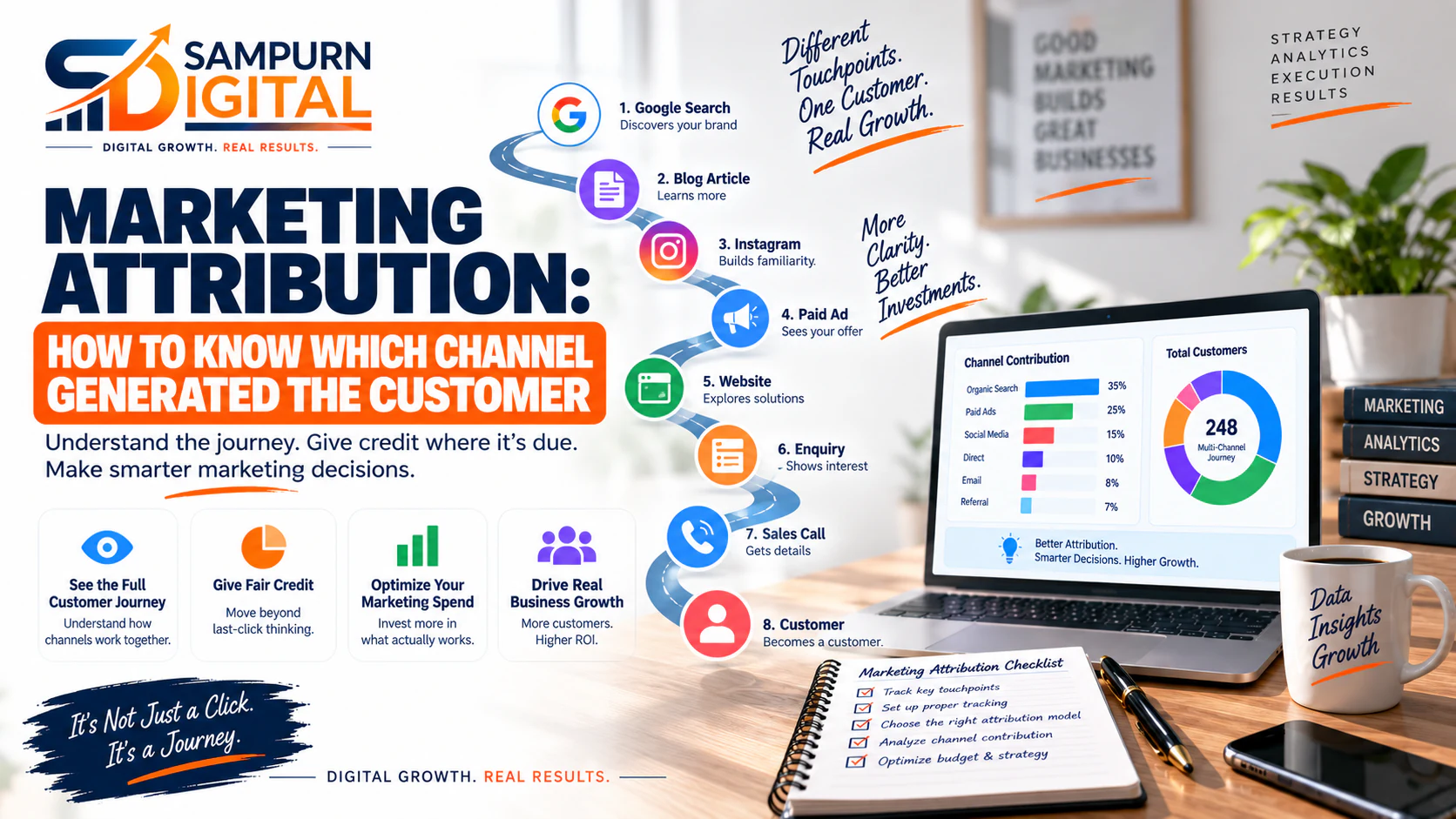
A customer rarely discovers a business through just one marketing channel.
They might:
- Find your website through Google
- See your Instagram content
- Click a paid advertisement
- Return through a remarketing campaign
- Read a blog
- Visit your pricing page
- Submit a form
- Speak with your sales team
- Become a customer days or weeks later
Then the business asks:
“Which marketing channel actually generated this customer?”
The answer is often not as simple as looking at the last click.
If you give all the credit to the final interaction, you may conclude that one channel is performing extremely well while ignoring the channels that helped create demand earlier in the journey.
This is where marketing attribution for small business becomes important.
Attribution helps you understand how different marketing interactions contribute to leads, opportunities and customers so you can make better budget and strategy decisions.
First: Don't Assume the Last Click Created the Customer
Imagine a customer journey like this:
Which channel generated the customer?
Google?
Instagram?
Paid advertising?
The website?
The sales team?
The answer depends on the attribution model and the question you're trying to answer.
The problem is not that attribution is impossible.
The problem is that businesses often use one simplistic attribution number to make complicated marketing decisions.
Understand What Marketing Attribution Means
Marketing attribution is the process of connecting marketing interactions with outcomes such as:
- Leads
- Sales opportunities
- Purchases
- Revenue
The purpose is to understand:
Which channels, campaigns and touchpoints contributed to business results?
For example, you may want to know:
- Which channel generates the first interaction?
- Which channel generates the final conversion?
- Which campaign assists conversions?
- Which source generates the highest-quality leads?
- Which channel produces the most revenue?
- Which channels work together?
These are different questions.
That means there is no single attribution view that answers everything.
Start With the Customer Journey
Before choosing an attribution model, map the journey.
A simple service-business journey might look like:
Stage 1: Discovery
The prospect sees a social post or searches Google.
Stage 2: Research
They visit your website and read educational content.
Stage 3: Evaluation
They compare your business with alternatives.
Stage 4: Intent
They visit a service page or pricing page.
Stage 5: Conversion
They submit an enquiry or book a consultation.
Stage 6: Sales
The sales team qualifies and closes the opportunity.
Stage 7: Revenue
The customer purchases.
This is why a broader understanding of [a practical digital growth funnel guide](https://chatgpt.com/blog/digital-marketing/the-complete-digital-growth-funnel-from-first-click-to-customer) is useful before evaluating attribution.
Attribution should reflect the journey rather than treating every conversion as a single isolated click.
Define What You Are Actually Trying to Attribute
Do not begin with:
“Which channel gets credit?”
Begin with:
“What outcome are we trying to understand?”
You may want to attribute:
- Website enquiries
- Phone calls
- Form submissions
- Demo requests
- Consultation bookings
- Purchases
- Qualified leads
- Sales opportunities
- Revenue
These are not interchangeable.
A channel that generates many leads may generate few qualified opportunities.
Another channel may generate fewer leads but significantly more revenue.
The attribution question must therefore be connected to the business objective.
Track More Than Leads
Consider this example:
| Channel | Leads | Qualified Leads | Customers | Revenue |
|---|---|---|---|---|
| SEO | 100 | 40 | 10 | ₹5,00,000 |
| Paid Ads | 150 | 35 | 6 | ₹3,00,000 |
| Social | 120 | 15 | 2 | ₹80,000 |
| Referral | 30 | 20 | 8 | ₹4,00,000 |
If you only look at lead volume, paid ads appear strongest.
If you look at customers, SEO and referrals become much more interesting.
If you look at revenue, SEO may be the strongest acquisition channel.
This is why attribution should eventually connect:
Understand First-Touch Attribution
First-touch attribution gives credit to the first recorded marketing interaction.
For example:
Google receives the credit.
This model can be useful for understanding:
Which channels introduce people to our business?
It is particularly useful for demand-generation analysis.
However, it has an obvious limitation.
The first interaction may happen weeks before the customer converts.
Other channels may have played an important role afterward.
Understand Last-Touch Attribution
Last-touch attribution gives credit to the final tracked marketing interaction before conversion.
For example:
Paid retargeting receives the conversion credit.
This is easy to understand and useful for some campaign-level analysis.
But it can also create misleading conclusions.
The retargeting ad may have converted someone who already discovered the business through SEO and social media.
The final touch was important.
But it was not necessarily the only reason the person became a customer.
Understand Multi-Touch Attribution
Multi-touch attribution attempts to distribute credit across multiple interactions.
For example:
Instead of giving 100% credit to one channel, the model distributes credit among multiple touchpoints.
This can provide a more complete view.
However, more sophisticated attribution also requires:
- Better tracking
- Consistent data
- Clear definitions
- More careful interpretation
More complexity does not automatically mean more accuracy.
Don't Confuse Attribution With Causation
This is one of the most important points.
If a customer interacted with an advertisement before purchasing, that does not automatically prove the advertisement caused the purchase.
The customer may already have been highly interested.
Similarly, if someone searched your brand name immediately before purchasing, branded search may receive the final credit even though earlier marketing created the demand.
Attribution tells you about observed interactions.
It does not perfectly reveal what would have happened if a particular interaction had never existed.
Use attribution as a decision-support system—not as absolute proof of causation.
Track the Source From the First Visit
A strong attribution setup should preserve useful information about how a person entered your marketing ecosystem.
Depending on the setup, this may include:
- Source
- Medium
- Campaign
- Landing page
- Search interaction
- Paid campaign
- Referral
- Content interaction
The goal is to avoid losing the original acquisition context when the person returns later.
For website conversion tracking, see [how conversion-focused web development works](https://chatgpt.com/blog/web-development/how-to-track-website-conversions-correctly-with-ga4-and-gtm).
Connect Marketing Data With CRM Data
Website analytics alone may tell you:
“This visitor submitted a form.”
But the business needs to know:
“Did this form submission become a qualified opportunity?”
And eventually:
“Did this opportunity become ₹2,00,000 in revenue?”
This requires connecting marketing activity with sales outcomes.
A useful data chain is:
Without this connection, marketing teams often optimize for metrics that stop before the actual business outcome.
Track Lead Quality by Channel
Not all leads have equal value.
Imagine:
Channel A
100 leads 20 qualified 5 customers
Channel B
50 leads 30 qualified 12 customers
Channel A generated twice as many leads.
But Channel B generated more customers.
Therefore, the right question is not:
“Which channel gives us the cheapest lead?”
It is:
“Which channel gives us valuable customers at an acceptable acquisition cost?”
This distinction can completely change your marketing budget decisions.
Understand Paid Marketing Attribution
Paid campaigns often have detailed attribution data.
You may be able to see:
- Campaign
- Ad set
- Advertisement
- Keyword
- Search term
- Landing page
- Conversion
- Cost
But paid platforms naturally emphasize their own contribution.
That is why you should compare paid-platform reporting with your broader analytics and CRM data.
For a deeper paid-specific approach, see [performance marketing and paid acquisition for businesses](https://chatgpt.com/blog/performance-marketing/paid-marketing-attribution-how-to-track-the-complete-conversion-journey).
Don't Ignore Organic Search
SEO can be particularly difficult to evaluate because a customer may interact with organic content long before becoming a lead.
For example:
If you only look at the final interaction, SEO's contribution may be underestimated.
This is why marketing attribution should be combined with [SEO strategy and organic search guide](https://chatgpt.com/blog/seo/seo-reporting-for-business-owners-what-numbers-actually-matter).
Separate Acquisition From Conversion
A useful way to think about attribution is:
Acquisition
How did the person first discover us?
Engagement
Which channels helped them learn more?
Conversion
What caused the tracked conversion event?
Revenue
Which marketing journey ultimately produced business value?
These questions may have different answers.
That is completely normal.
Use Assisted Conversions as a Concept
Some channels may rarely appear as the final conversion source but still influence many customer journeys.
For example:
A person may:
The paid ad may receive last-touch credit.
But SEO and social contributed to the journey.
This is why assisted interactions can be useful when evaluating channel roles.
Compare Attribution Models Instead of Worshipping One
For important decisions, compare multiple views.
For example:
| Question | Useful Attribution View |
|---|---|
| What introduces new prospects? | First touch |
| What is closing conversions? | Last touch |
| What channels appear throughout journeys? | Multi-touch |
| What produces customers? | CRM-connected analysis |
| What produces revenue? | Revenue attribution |
| What creates demand? | Journey + channel analysis |
The objective is not to choose one model and declare it perfect.
The objective is to understand different parts of the customer journey.
Watch for Common Attribution Problems
Problem 1: Missing tracking
If tracking breaks, attribution becomes incomplete.
Problem 2: Direct traffic receives too much credit
Returning visitors may appear as direct even though another channel introduced them earlier.
Problem 3: Cross-device journeys
A customer may research on mobile and convert on desktop.
Problem 4: Offline sales
A lead may submit a form online but close through a phone call or meeting.
Problem 5: Long buying cycles
A B2B prospect may interact with your marketing for months before becoming a customer.
Problem 6: Platform discrepancies
Different platforms may report conversions differently.
Problem 7: Duplicate conversions
Poor event configuration can make one action look like multiple conversions.
These problems should be diagnosed before making major budget decisions.
Use Attribution to Improve Budget Allocation
Suppose your monthly marketing budget is:
Current allocation:
- SEO: ₹75,000
- Paid Ads: ₹1,25,000
- Social: ₹50,000
- Content: ₹25,000
- Other: ₹25,000
After connecting marketing and sales data, you discover that SEO produces fewer leads but substantially more high-value customers.
That information may justify changing the allocation.
But do not make decisions based on one month of data.
Consider:
- Sales cycle
- Lead volume
- Customer value
- Seasonality
- Channel maturity
- Attribution limitations
- Marginal acquisition cost
Attribution should support strategic decisions rather than trigger constant budget changes.
Don't Optimize for the Cheapest Lead
A ₹300 lead is not automatically better than a ₹1,000 lead.
Suppose:
Channel A
Cost per lead: ₹300 100 leads 2 customers
Channel B
Cost per lead: ₹1,000 40 leads 10 customers
Channel B produces more expensive leads.
But it may produce significantly cheaper customers.
This is why channel evaluation should move beyond CPL.
Useful metrics include:
- Cost per qualified lead
- Cost per opportunity
- Customer acquisition cost
- Revenue per customer
- Return on investment
- Customer lifetime value
For a broader understanding of these business metrics, see [ROAS vs ROI vs CAC vs LTV explained for businesses](https://chatgpt.com/blog/digital-marketing/roas-vs-roi-vs-cac-vs-ltv-which-metric-should-you-actually-use).
Create a Simple Attribution Dashboard
A practical dashboard can include:
| Metric | Purpose |
|---|---|
| First-touch source | Understand acquisition |
| Last-touch source | Understand conversion |
| Leads by channel | Measure lead generation |
| Qualified leads | Measure quality |
| Opportunities | Measure sales potential |
| Customers | Measure acquisition |
| Revenue | Measure business value |
| CAC | Measure efficiency |
| Conversion rate | Measure funnel performance |
Do not create dozens of charts simply because the data exists.
The dashboard should answer business questions.
For ongoing management, [a practical marketing dashboard guide](https://chatgpt.com/blog/digital-marketing/marketing-dashboard-what-should-a-business-track-every-week) can help define the metrics your team should actually review.
Build a Simple Attribution Framework
Use this framework:
Define the conversion
What counts as a meaningful business conversion?
Define the customer journey
What interactions can happen before conversion?
Track acquisition
Where did the prospect originally come from?
Track interactions
What marketing channels did they use?
Connect the lead
Can the marketing record be connected to the CRM?
Track sales
Did the lead become an opportunity?
Track revenue
How much revenue did the customer generate?
Compare channels
Which channels contribute to valuable outcomes?
Identify limitations
Where is your data incomplete?
Make decisions
Use the evidence to improve budget, campaigns and strategy.
A Practical Attribution Table
A simple reporting structure can look like this:
| Customer | First Touch | Key Interactions | Last Touch | Revenue |
|---|---|---|---|---|
| Customer A | SEO | SEO → Social → Website | Paid | ₹1,50,000 |
| Customer B | Social | Social → Website → Email | Organic | ₹80,000 |
| Customer C | Paid | Paid → Website → Retargeting | Paid | ₹2,00,000 |
| Customer D | Referral | Referral → Website → Direct | Direct | ₹1,20,000 |
This allows the team to see the customer journey rather than looking at isolated channel reports.
What to Do When Attribution Data Disagrees
It is normal for different systems to report different numbers.
For example:
Google Ads: 25 conversions
Analytics: 19 conversions
CRM: 16 qualified leads
Sales system: 7 customers
This does not automatically mean one system is broken.
Each system may be measuring a different stage or using different attribution rules.
Start by asking:
- What exactly is each platform counting?
- What is the conversion definition?
- What attribution window is being used?
- Are duplicate events possible?
- Are offline conversions included?
- Are leads being qualified consistently?
Then reconcile the systems.
Sometimes the best-performing channel is not obvious.
For example:
A blog may generate few direct leads.
But people who read the blog may later:
- Return through branded search
- Visit the service page
- Click an ad
- Submit a form
- Become customers
The blog may therefore play a valuable role even if its last-click numbers look weak.
Attribution helps you ask better questions about these journeys.
Don't Change Your Strategy Every Time the Attribution Report Changes
Marketing data can fluctuate.
A channel may appear stronger because:
- Campaign mix changed
- Seasonality changed
- Tracking changed
- Sales cycle changed
- Traffic changed
- Customer behavior changed
Do not make major decisions based on one unusual week.
Look for meaningful patterns.
Review:
- Month-over-month performance
- Customer cohorts
- Channel quality
- Revenue
- Acquisition cost
- Sales cycle
- Attribution consistency
Then make decisions.
Marketing Attribution Is a Decision System
The ultimate purpose of attribution is not producing a beautiful report.
It is helping answer questions such as:
Where should we invest more?
Which channel is attracting valuable customers?
Which campaigns should we improve?
Which channels assist conversions?
Where are leads becoming customers?
Where are we wasting budget?
Which marketing activities deserve more resources?
If attribution cannot help answer these questions, it may be measuring activity rather than business performance.
Don't Try to Make Attribution Perfect Before Using It
Perfect attribution is unrealistic.
Customer journeys are complicated.
People:
- Switch devices
- Clear cookies
- Search independently
- Talk to sales
- Visit directly
- Discover brands offline
- Use multiple channels
- Take weeks or months to decide
Instead of waiting for perfect tracking, build a useful system.
Start with:
Then improve the detail over time.
Attribution Checklist
Before relying on your marketing attribution data, check:
- Conversion events are clearly defined
- Lead sources are being captured
- Campaign tracking is consistent
- Website conversions are tracked
- CRM records connect to leads
- Qualified leads are identified
- Opportunities are tracked
- Customers are tracked
- Revenue is recorded
- First-touch data is available where possible
- Last-touch data is available
- Paid campaign data is connected
- Organic search is considered
- Social interactions are considered
- Offline conversions are considered
- Duplicate conversions are checked
- Attribution windows are understood
- Platform differences are documented
- Channel quality is measured
- Customer acquisition cost is measured
- Revenue is connected to acquisition
- Attribution limitations are documented
Final Diagnosis: Attribution Is About Understanding the Journey
The question:
“Which channel generated this customer?”
sounds simple.
But modern customer journeys rarely are.
A customer may discover your business through SEO, interact with social media, click a paid advertisement and eventually convert through your website.
Giving 100% credit to one interaction can hide the contribution of the others.
A better approach is to understand the entire journey:
Then evaluate channels against the business outcomes that matter.
The goal is not to prove that one channel is responsible for every customer.
The goal is to understand:
How marketing channels work together to create qualified leads, customers and revenue.
That is what makes marketing attribution for small business useful.
When attribution is connected to CRM and revenue data, businesses can move from:
to:
And that creates a much stronger foundation for future marketing decisions.
