
A lead magnet can generate hundreds of downloads and still produce almost no customers.
That is the problem many businesses face.
They create:
- An ebook
- A checklist
- A free PDF
- A webinar
- A template
- A guide
Then they celebrate because people are downloading it.
But a bigger question remains:
A lead magnet should not exist simply to collect email addresses.
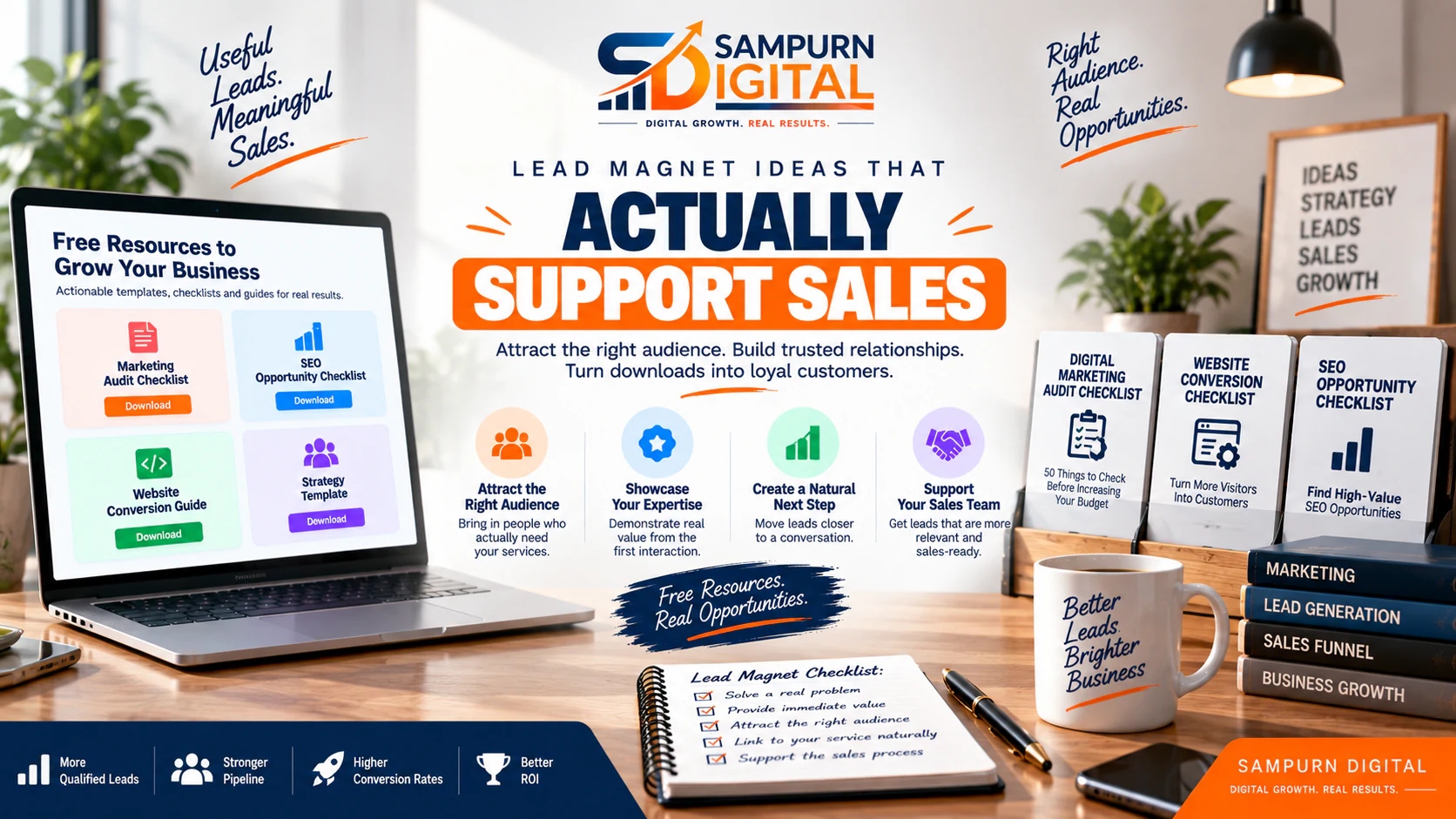
It should attract the right audience, demonstrate your expertise, solve part of a real problem and create a natural next step toward your product or service.
That is what makes a lead magnet useful for sales.
This guide explains how to create lead magnet ideas for service businesses that support the entire customer journey instead of becoming another disconnected marketing asset.
First: Don't Start With "What Can We Give Away?"
A common mistake is starting with:
“Let's create a free ebook.”
“Let's make a checklist.”
The format is not the strategy.
Start with the customer.
Ask:
What problem does our ideal customer already want help solving?
For example, a digital marketing agency could create:
50 Digital Marketing Tips
Digital Marketing Audit Checklist: 50 Things to Check Before Increasing Your Budget
The second is more specific.
It attracts someone who already has a business problem.
That person is more likely to have a genuine need for marketing services.
A good lead magnet therefore starts with customer problem + useful outcome, not a content format.
Understand What a Lead Magnet Actually Does
A lead magnet is a valuable resource offered in exchange for contact information or another low-friction action.
Its purpose is to:
- Attract the right audience
- Demonstrate expertise
- Provide immediate value
- Identify potential prospects
- Begin a relationship
- Create a logical next step
The lead magnet is therefore an entry point into your marketing funnel.
It should not be treated as the final destination.
For a broader understanding of how this fits into lead generation, see [our guide to build a lead generation system for a service business](https://chatgpt.com/blog/digital-marketing/how-to-build-a-lead-generation-system-for-a-service-business).
Choose a Problem With Commercial Relevance
Not every problem makes a good lead magnet.
The best problems usually have a connection to something the business sells.
For example:
SEO Agency
Lead magnet:
SEO Opportunity Checklist
Commercial connection:
SEO services
Web Development Company
Lead magnet:
Website Conversion Audit Checklist
Commercial connection:
Website development and CRO
Performance Marketing Agency
Lead magnet:
Google Ads Waste Detection Checklist
Commercial connection:
Paid advertising management
Digital Marketing Agency
Lead magnet:
Digital Growth Audit Framework
Commercial connection:
Digital marketing strategy and execution
The closer the problem is to the service, the easier it becomes to move the lead toward a sales conversation.
Solve One Specific Problem
A lead magnet becomes weaker when it tries to solve everything.
Avoid:
The Ultimate Guide to Everything About Digital Marketing
Instead:
25-Point Website Lead Generation Checklist
Google Ads Audit Checklist for Businesses
SEO Content Planning Template for Service Businesses
Specificity makes the resource easier to understand and easier to promote.
It also helps attract a more relevant audience.
Create a Lead Magnet That Gives a Quick Win
The best lead magnets often help someone accomplish something quickly.
For example:
- Identify five SEO problems
- Calculate marketing ROI
- Plan a content calendar
- Audit a Google Ads account
- Review a website
- Define a target audience
- Create a campaign brief
- Map a customer journey
The user should be able to think:
“I can use this immediately.”
That is usually more valuable than giving them 100 pages of theory.
Lead Magnet Ideas for Service Businesses
Here are practical categories you can adapt.
Checklists
Checklists work well because they are simple and actionable.
Examples:
- SEO Audit Checklist
- Website Launch Checklist
- Google Ads Audit Checklist
- Social Media Audit Checklist
- Digital Marketing Audit Checklist
- Lead Generation Checklist
- Website Conversion Checklist
Templates
Templates are useful when the customer needs to create something.
Examples:
- Marketing Brief Template
- Content Calendar Template
- Campaign Planning Template
- Customer Journey Map
- SEO Content Brief
- Social Media Planning Template
- Marketing KPI Dashboard
The value comes from saving the user time.
Calculators
Calculators can attract users with commercial intent.
Examples:
- Customer Acquisition Cost Calculator
- Marketing ROI Calculator
- ROAS Calculator
- Lead Conversion Calculator
- Website Conversion Calculator
- Marketing Budget Calculator
These are especially useful when the calculation connects directly to a business decision.
Audits and Assessments
Audits are particularly powerful for service businesses because the output naturally identifies problems that may require professional help.
Examples:
- SEO Opportunity Assessment
- Website Conversion Assessment
- Google Ads Account Audit
- Social Media Audit
- Digital Marketing Health Check
- Lead Generation Assessment
A good assessment should provide useful information rather than simply telling the prospect:
“Contact us to learn more.”
Industry Reports
Reports can work well when your business has access to meaningful data.
Examples:
- Ecommerce Marketing Benchmark Report
- Local Business Digital Growth Report
- Social Media Performance Benchmark
- Digital Advertising Trends Report
Reports can also support authority and brand positioning.
Guides
Guides work best when they solve a defined problem.
Examples:
- Complete SEO Planning Guide
- Website Redesign Planning Guide
- Digital Marketing Roadmap
- Lead Generation Planning Guide
- Paid Advertising Launch Guide
Avoid making the guide broad simply to make it longer.
Swipe Files and Examples
People often want to see what good execution looks like.
Examples:
- Landing Page Examples
- Ad Copy Examples
- Social Media Hook Examples
- CTA Examples
- Email Subject Line Examples
- Lead Generation Offer Examples
The important part is explaining why the examples work.
Free Strategy Sessions
For high-value services, the lead magnet does not always have to be a downloadable document.
It could be:
Free 30-Minute Digital Growth Consultation
or:
Free Website Conversion Review
The value is the expertise and diagnosis.
This can work particularly well when the service requires customization.
Match the Lead Magnet to the Funnel Stage
Different visitors need different resources.
Awareness Stage
Use educational resources.
Examples:
- Beginner guides
- Industry reports
- Problem checklists
Consideration Stage
Use decision-support resources.
Examples:
- Comparison guides
- Audit checklists
- Templates
- Frameworks
Decision Stage
Use resources that reduce buying uncertainty.
Examples:
- Consultation
- Assessment
- Case study
- Proposal
- Strategy session
The lead magnet should therefore match the visitor's level of awareness.
Don't Optimize for Downloads Alone
This is one of the most important principles.
Suppose:
Lead Magnet A
5,000 downloads 100 qualified leads 5 customers
Lead Magnet B
500 downloads 150 qualified leads 20 customers
Lead Magnet B is clearly more valuable.
The objective is not:
Maximum downloads
It is:
Maximum qualified business opportunity.
Track the full journey.
Build the Follow-Up Before Launching the Lead Magnet
A lead magnet without follow-up is incomplete.
Before launching, decide what happens after someone downloads it.
A basic sequence might be:
Day 0
Deliver the resource.
Day 1–2
Provide an additional useful insight.
Day 3–4
Explain a common mistake related to the problem.
Day 5–7
Show a relevant case study or example.
Later
Present the relevant service or consultation.
The exact sequence depends on the business and buying cycle.
The important point is:
Create a Natural Bridge to Your Service
The transition from lead magnet to service should make sense.
For example:
Website Conversion Audit Checklist
The visitor identifies several conversion weaknesses.
Get a professional website conversion assessment.
Google Ads Waste Checklist
The business identifies potential wasted spend.
Request a paid advertising audit.
The service becomes the logical continuation of the problem.
Use the Lead Magnet to Qualify Prospects
A lead magnet can also provide information about what the prospect cares about.
For example, someone downloads:
Ecommerce SEO Checklist
This tells you something.
Someone downloads:
Website Redesign Planning Guide
That tells you something different.
You can use this information to segment prospects.
Possible segments:
- SEO interest
- Paid advertising interest
- Website interest
- Social media interest
- Lead generation interest
This makes follow-up more relevant.
Put the Lead Magnet on the Right Pages
Do not place one generic lead magnet everywhere.
Match the resource to the page.
For example:
SEO Blog
Offer:
SEO Content Planning Checklist
Paid Advertising Article
Offer:
Google Ads Audit Checklist
Website Article
Offer:
Website Conversion Checklist
Lead Generation Article
Offer:
Lead Generation Funnel Template
Context increases relevance.
Use SEO to Generate Long-Term Lead Magnet Traffic
Lead magnets can become part of your organic acquisition system.
Create useful content around the problem.
Then connect that content to the relevant resource.
For example:
How to Improve Website Conversion Rate
Website Conversion Audit Checklist
Website Conversion / Web Development Consultation
This creates a clear progression from search traffic to lead generation.
A strong content system should connect topics to customer journeys, which is why [SEO strategy and organic search guide](https://chatgpt.com/blog/seo/how-to-build-an-seo-content-calendar-around-customer-journeys) can support this approach.
Use Social Media to Promote the Resource
Social media can create demand around the problem.
For example:
Post
Your website gets traffic but very few enquiries?
Explain three common conversion problems.
Then:
Download our free website conversion checklist to identify the issues.
The social post creates awareness.
The lead magnet captures interest.
The follow-up process develops the relationship.
This is much stronger than simply posting:
“Download our ebook.”
For content repurposing and distribution, see [how social media growth strategy works](https://chatgpt.com/blog/social-media-marketing/how-to-turn-one-business-topic-into-30-social-media-posts).
Create a Landing Page Specifically for the Lead Magnet
The landing page should communicate:
What it is
Clearly name the resource.
Who it is for
Explain the intended audience.
What it helps them do
Focus on the outcome.
What they will receive
List the contents.
Why they should trust you
Add relevant proof.
What happens next
Set expectations.
Avoid unnecessary distractions.
The landing page has one primary job:
Convince the right visitor that the resource is worth receiving.
Keep the Form Appropriate to the Value
A free checklist probably should not require:
- Company revenue
- 15 questions
- Multiple verification steps
- Detailed business history
The friction should match the value.
For a simple resource:
- Name
may be enough.
For a high-value assessment:
- Name
- Company
- Website
- Business goal
- Service requirement
may make sense.
The right question is:
What information do we genuinely need?
Make the Lead Magnet Good Enough to Demonstrate Expertise
Your lead magnet is also a sample of your expertise.
If the resource is:
- Generic
- Poorly designed
- Full of obvious advice
- Outdated
- Too promotional
the prospect may assume your paid service is similar.
Instead, demonstrate your thinking.
Give them:
- Practical frameworks
- Specific examples
- Clear processes
- Useful calculations
- Real decision criteria
- Actionable recommendations
The prospect should finish thinking:
“If this is what they give away, their paid expertise is probably valuable.”
Avoid Making the Lead Magnet a Sales Brochure
The lead magnet should provide genuine value.
Avoid turning every page into:
“Our agency can help you.”
Instead:
- Solve part of the problem.
- Explain what the customer can do.
- Show where professional support may be useful.
- Provide a clear next step.
This builds trust.
Measure the Lead Magnet as a Business Asset
Create a simple performance model.
| Metric | What It Tells You |
|---|---|
| Landing page visitors | Demand |
| Conversion rate | Offer appeal |
| Downloads | Lead volume |
| Qualified leads | Lead quality |
| Sales opportunities | Commercial value |
| Customers | Actual outcome |
| Revenue | Business impact |
| Cost per lead | Acquisition efficiency |
| Cost per customer | Profitability |
This prevents the team from declaring success because the download count looks impressive.
For ongoing measurement, [how to improve marketing attribution](https://chatgpt.com/blog/digital-marketing/marketing-attribution-how-to-know-which-channel-generated-the-customer) becomes important when multiple channels contribute to the same lead.
Compare Lead Magnets by Revenue, Not Popularity
Suppose you have three resources:
| Lead Magnet | Leads | Customers | Revenue |
|---|---|---|---|
| Marketing Tips Ebook | 1,000 | 3 | ₹60,000 |
| Website Audit Checklist | 300 | 8 | ₹2,00,000 |
| Growth Consultation | 100 | 12 | ₹4,00,000 |
The ebook appears to be the winner if you only measure leads.
The consultation is the clear winner if you measure revenue.
This changes how you allocate marketing effort.
Use Lead Magnets as Part of a Larger Growth System
A lead magnet should connect:
That is why lead magnets should not be created in isolation.
They are one component of the wider marketing system.
For the larger connection between SEO, paid advertising, content and website conversion, see [how SEO strategy and organic search works](https://chatgpt.com/blog/seo/how-seo-paid-ads-content-and-website-cro-work-together-as-one-growth-system).
Don't Create a Lead Magnet Just Because Everyone Else Has One
A lead magnet is useful when it solves a real problem.
You do not need one simply because competitors have:
- Ebooks
- PDFs
- Webinars
- Checklists
- Newsletters
Ask:
Does this resource attract our ideal customer?
Does it solve a meaningful problem?
Does that problem connect to our service?
Does it create a logical next step?
If not, it may create more marketing work without creating meaningful business value.
Don't Create Ten Lead Magnets at Once
Start with one strong resource.
Test it.
Measure:
- Conversion rate
- Lead quality
- Sales opportunities
- Customer conversion
- Revenue
Then improve or expand.
A useful progression is:
Once that works, build additional resources for other high-value customer problems.
A Practical Lead Magnet Framework
Use this five-step framework.
Identify the Problem
What is your ideal customer struggling with?
Define the Quick Win
What useful result can you help them achieve quickly?
Choose the Format
Checklist, template, calculator, audit, guide, report or consultation.
Connect It to Your Service
What logical paid solution follows the problem?
Build the Follow-Up
What happens after someone downloads or requests the resource?
If all five are clear, you have the foundation of a useful lead magnet.
Lead Magnet Checklist
Before launching a resource, confirm:
- The target audience is specific
- The customer problem is clear
- The problem has commercial relevance
- The resource provides a useful outcome
- The format matches the problem
- The lead magnet is specific
- The resource provides a quick win
- The landing page explains the value
- The form has appropriate friction
- The resource demonstrates expertise
- The lead magnet is not just a sales brochure
- A follow-up sequence exists
- The next service step is logical
- Leads can be segmented
- Lead quality is measured
- Sales opportunities are tracked
- Customers are tracked
- Revenue is connected to the resource
- Attribution is considered
- The resource is promoted through relevant channels
Final Diagnosis: The Best Lead Magnet Is Not the One With the Most Downloads
A lead magnet should not be judged by how impressive its download number looks.
Its real value is determined by what happens after the download.
A strong lead magnet:
The goal is therefore not:
“How many people can we get to download this?”
The better question is:
“Does this resource attract people who could realistically become customers?”
If the answer is yes, the lead magnet becomes a valuable part of the acquisition system.
If it attracts thousands of people who have no connection to your service, it may produce impressive marketing numbers while contributing very little revenue.
That is why lead magnet ideas for service businesses should always be evaluated against customer fit, commercial relevance and downstream sales—not just downloads.
And once the resource is generating leads, the next step is to understand exactly which channels and campaigns are producing those customers using [a practical marketing dashboard guide](https://chatgpt.com/blog/digital-marketing/marketing-dashboard-what-should-a-business-track-every-week) and the right attribution framework.
