
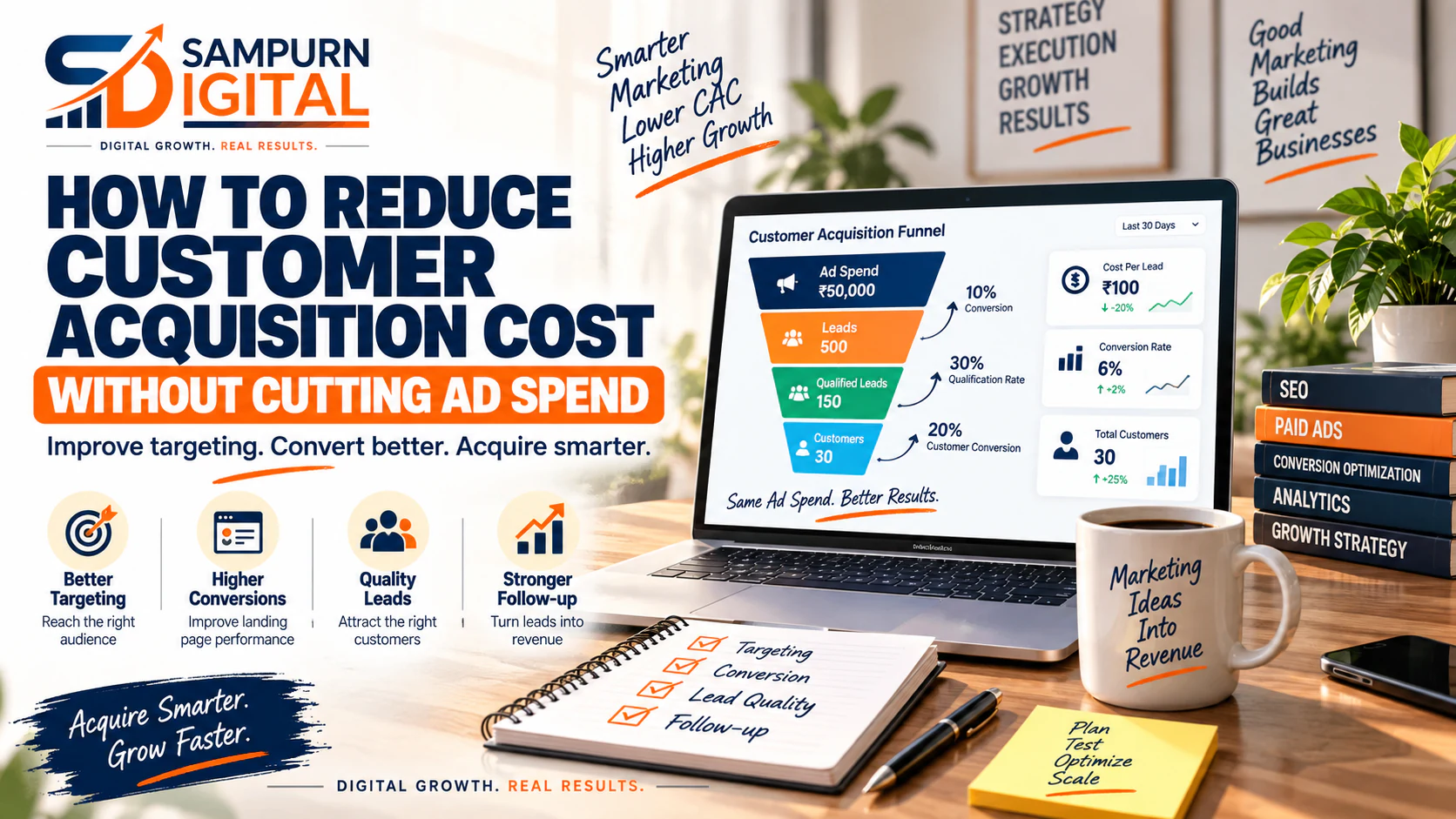
Customer acquisition cost is one of the clearest signals of whether your marketing is becoming more efficient—or more expensive.
But when CAC increases, many businesses make the same decision:
That can reduce spending temporarily, but it does not necessarily make acquisition more efficient.
If the underlying problem is poor targeting, weak conversion rates, low lead quality, slow sales follow-up, or low customer value, cutting spend simply reduces the number of opportunities entering the system.
The better question is:
This guide breaks down the major drivers of customer acquisition cost and shows how to identify the real source of rising CAC.
First: Don't Assume High CAC Means You Are Spending Too Much
Customer acquisition cost is often treated as an advertising metric.
It is not.
CAC is a full-funnel business metric.
A simplified calculation is:
CAC=Total Sales and Marketing CostNew CustomersCAC \= \\frac{Total\\ Sales\\ and\\ Marketing\\ Cost}{New\\ Customers}
For example:
- Marketing and sales spend \= ₹5,00,000
- New customers \= 100
Your blended CAC is:
Now imagine you reduce your marketing spend to ₹3,00,000.
But new customers fall to 40.
Your new CAC becomes:
You spent less.
But acquisition became more expensive.
That is why reducing spend and reducing CAC are not the same thing.
Understand What Is Actually Driving Your CAC
CAC can increase for many different reasons.
For example:
So before changing your budget, break CAC into its underlying components.
A useful funnel is:
Every stage affects acquisition economics.
Separate Cost Per Click From Cost Per Customer
A common mistake is assuming expensive clicks automatically mean expensive customers.
They do not.
Consider two campaigns:
| Campaign | CPC | Lead Rate | Lead Cost | Sales Rate | CAC |
|---|---|---|---|---|---|
| A | ₹50 | 5% | ₹1,000 | 10% | ₹10,000 |
| B | ₹100 | 10% | ₹1,000 | 20% | ₹5,000 |
Campaign B has a much higher CPC.
Yet it produces customers at half the CAC.
This is why optimizing only for:
- CPC
- CPM
- CTR
- CPL
can produce misleading conclusions.
The ultimate question is:
Improve Targeting Before Increasing or Cutting Budget
One of the fastest ways to improve acquisition efficiency is to make sure your marketing reaches people who are actually capable of becoming customers.
Look at:
- audience characteristics
- search intent
- customer problems
- geography
- industry
- company size
- product/service fit
- purchasing power
- funnel stage
Broad targeting can generate attractive traffic numbers while producing poor business results.
For example:
may be worse than:
More traffic does not necessarily mean better acquisition.
If you need to evaluate which channels deserve investment in the first place, review [which marketing channel your business should invest in first](https://www.sampurndigital.com/blog/digital-marketing/which-marketing-channel-should-your-business-invest-in-first).
Improve Traffic Quality, Not Just Traffic Volume
The cheapest traffic is not always the most valuable traffic.
A traffic source should be evaluated based on what happens after the click.
For each major source, measure:
- visitors
- leads
- qualified leads
- opportunities
- customers
- revenue
- acquisition cost
For example:
| Channel | Visitors | Leads | Customers | CAC |
|---|---|---|---|---|
| Organic Search | 10,000 | 300 | 30 | ₹2,500 |
| Paid Search | 5,000 | 250 | 25 | ₹4,000 |
| Social | 15,000 | 200 | 8 | ₹9,000 |
| Referral | 1,000 | 100 | 20 | ₹1,500 |
Social may generate more visitors than referral traffic.
But referral traffic produces customers at a much lower cost.
This is why channel-level CAC is often more useful than a single blended number.
Increase Conversion Rate Before Buying More Traffic
Suppose you spend ₹2,00,000 to generate:
If your website converts at 2%, you generate:
Now improve the conversion rate to 3%.
The same 10,000 visitors generate:
You increased leads by 50% without increasing traffic spend.
This is one of the most powerful ways to improve acquisition efficiency.
Look at:
- landing-page relevance
- headlines
- offers
- CTAs
- forms
- trust signals
- testimonials
- pricing information
- mobile UX
- page speed
- booking process
If your website is generating traffic but converting too few visitors, the problem may be further down the funnel rather than at the acquisition stage.
Our guide on [how to improve website conversion rate without redesigning everything](https://www.sampurndigital.com/blog/web-development/how-to-improve-website-conversion-rate-without-redesigning-everything) explores this in more detail.
Improve Lead Quality Instead of Chasing Cheap Leads
A low cost per lead can create a dangerous illusion.
Imagine:
Campaign A
- CPL \= ₹500
- 1,000 leads
- 10 customers
CAC:
Campaign B
- CPL \= ₹1,500
- 300 leads
- 20 customers
CAC:
Campaign B generates more expensive leads.
But it acquires customers for less.
This is why businesses should distinguish between:
and
The goal is not to minimize CPL at all costs.
The goal is to improve the relationship between:
Fix the Lead-to-Sale Conversion Rate
Sometimes the marketing team is generating enough qualified leads.
The problem is that too few become customers.
Suppose:
- 100 qualified leads
- 5 customers
Your conversion rate is 5%.
If improvements to qualification, follow-up, sales messaging, or offer positioning increase that to 8%, the same 100 leads produce:
No additional advertising spend is required.
That directly improves acquisition economics.
Investigate:
- response time
- follow-up frequency
- qualification
- sales scripts
- proposal process
- objections
- pricing
- trust
- product-market fit
If marketing generates the opportunity but sales fails to convert it, increasing marketing spend is rarely the first solution.
Reduce Waste Inside Paid Campaigns
If paid advertising is a major acquisition channel, analyze where the budget is being wasted.
Look for:
- irrelevant search terms
- poor-performing audiences
- weak placements
- low-quality traffic
- unnecessary geographic targeting
- overlapping campaigns
- low-intent keywords
- weak creatives
- campaigns with poor downstream conversion
Do not judge a campaign only by clicks.
A campaign generating 1,000 cheap clicks but zero customers is not efficient.
A campaign generating 100 expensive clicks that produce five profitable customers may be much stronger.
Improve the Offer
Sometimes CAC is high because the market does not have a strong enough reason to buy.
Your offer should make the value proposition clear.
Ask:
- What problem are we solving?
- Who is this specifically for?
- Why should someone choose us?
- Why should they act now?
- What outcome are we promising?
- What risk does the customer perceive?
- Is the next step easy?
A weak offer creates friction throughout the funnel.
You may see:
Instead of:
Improving the offer can increase conversion at multiple stages simultaneously.
Increase Customer Value, Not Just Reduce Acquisition Cost
There is another way to improve acquisition economics:
Suppose:
- CAC \= ₹5,000
- Average customer value \= ₹10,000
Now suppose you increase customer value to ₹15,000 through:
- upsells
- cross-sells
- repeat purchases
- subscriptions
- longer retention
- service expansion
The same ₹5,000 CAC becomes much more attractive.
This is why CAC should be evaluated alongside customer lifetime value.
You can also review [ROAS vs ROI vs CAC vs LTV explained for businesses](https://www.sampurndigital.com/blog/digital-marketing/roas-vs-roi-vs-cac-vs-ltv-which-metric-should-you-actually-use) to understand how these metrics work together.
Compare CAC by Funnel Stage
A blended CAC can hide the real problem.
Build a table like this:
| Funnel Stage | Metric | Current | Target |
|---|---|---|---|
| Traffic | Cost per visitor | ₹20 | ₹18 |
| Traffic → Lead | Conversion rate | 2% | 3% |
| Lead | Cost per lead | ₹1,000 | ₹700 |
| Lead → Qualified | Qualification | 25% | 35% |
| Qualified → Sale | Sales conversion | 8% | 12% |
| Customer | CAC | ₹12,500 | ₹7,500 |
This tells you where improvement can have the greatest effect.
If traffic costs are reasonable but visitor-to-lead conversion is weak, changing ad spend will not solve the problem.
If leads are strong but sales conversion is weak, the focus should move further down the funnel.
Use a CAC Diagnosis Framework
When CAC increases, follow this sequence.
Confirm the increase
Compare CAC against:
- previous period
- previous quarter
- previous year
- channel benchmarks
- customer segments
Do not react to a short-term fluctuation without context.
Break down CAC
Calculate CAC by:
- channel
- campaign
- audience
- product/service
- location
- customer type
Identify the first major change
Ask:
For example:
- CPC increased
- conversion rate declined
- lead quality declined
- sales conversion declined
- average customer value declined
Find the highest-impact lever
Prioritize changes that can improve the economics of many customers.
Test before scaling
Make a measurable change.
Then compare the new result against the baseline.
Use This CAC Improvement Matrix
| Problem | Possible Fix | Expected Impact |
|---|---|---|
| CPC increasing | Improve targeting and creative | Lower traffic cost |
| Poor traffic quality | Refine audience and intent | Better lead quality |
| Low landing-page conversion | Improve offer and UX | More leads |
| High CPL | Remove inefficient traffic | Lower lead cost |
| Poor lead quality | Tighten qualification | More sales-ready leads |
| Low sales conversion | Improve follow-up and sales process | More customers |
| Low customer value | Improve retention and upsells | Better unit economics |
This prevents the common mistake of treating every CAC problem as an advertising problem.
Know When Cutting Spend Actually Makes Sense
Cutting spend is not always wrong.
It can make sense when:
- a channel consistently loses money
- customer economics are negative
- demand is temporarily weak
- tracking shows poor-quality acquisition
- the business cannot support the resulting sales volume
- a campaign has no credible path to profitability
But the decision should come from economics—not panic.
The question should be:
not:
That distinction can protect profitable acquisition while eliminating waste.
Build a Weekly CAC Review
CAC should not be reviewed only when revenue falls.
Create a recurring dashboard containing:
Acquisition
- spend
- impressions
- clicks
- traffic
- CPC
Lead generation
- leads
- CPL
- conversion rate
- qualified leads
Sales
- opportunities
- sales conversion
- customers
- sales cycle
Economics
- CAC
- average order/customer value
- revenue
- gross margin where available
- LTV
- channel profitability
Then ask three questions every week:
A broader [digital marketing performance dashboard](https://www.sampurndigital.com/blog/digital-marketing/marketing-dashboard-what-should-a-business-track-every-week) can help connect these numbers into one reporting system.
Don't Optimize CAC in Isolation
A lower CAC is not automatically better.
Suppose:
Scenario A
CAC \= ₹3,000 Customer value \= ₹4,000
Scenario B
CAC \= ₹5,000 Customer value \= ₹15,000
Scenario B may be significantly healthier.
Similarly, a channel with a higher CAC may produce:
- higher-value customers
- better retention
- larger contracts
- more repeat purchases
- stronger margins
The goal is therefore not:
The goal is:
CAC Improvement Checklist
Acquisition
- Are we targeting the right audience?
- Are high-intent segments clearly identified?
- Are inefficient campaigns being removed?
- Are channels evaluated on customer outcomes?
Traffic
- Is traffic relevant?
- Are CPC and traffic quality reviewed together?
- Are campaigns generating meaningful downstream actions?
Conversion
- Is the landing page relevant?
- Is the offer compelling?
- Are CTAs clear?
- Is the website easy to use?
- Is the mobile experience strong?
Lead Quality
- Are we tracking qualified leads?
- Are low-quality sources identified?
- Are targeting and qualification aligned?
Sales
- Are leads contacted quickly?
- Is follow-up consistent?
- Are sales objections recorded?
- Is the sales conversion rate improving?
Economics
- Is CAC measured by channel?
- Is customer value tracked?
- Are profitable channels separated from high-volume channels?
- Are decisions based on revenue and profitability rather than clicks alone?
Final Diagnosis: Reduce Waste Before You Reduce Growth
When customer acquisition cost increases, the instinct to cut advertising spend is understandable.
But it can be the wrong diagnosis.
CAC is influenced by the entire customer acquisition system:
If targeting is weak, improve targeting.
If traffic quality is poor, improve acquisition sources.
If conversion is weak, improve the website and offer.
If lead quality is poor, improve qualification.
If sales conversion is weak, improve the sales process.
If customer value is low, improve retention, upsells, or the underlying offer.
Only then should you decide whether the budget itself needs to change.
The strongest acquisition strategy is not necessarily the one that spends the least.
It is the one that consistently turns marketing investment into profitable customers.
If you want to evaluate your complete acquisition system, [Sampurn Digital’s Digital Marketing services](https://www.sampurndigital.com/digital-marketing-services) can help connect acquisition, conversion, analytics, and customer growth into one measurable system.
