
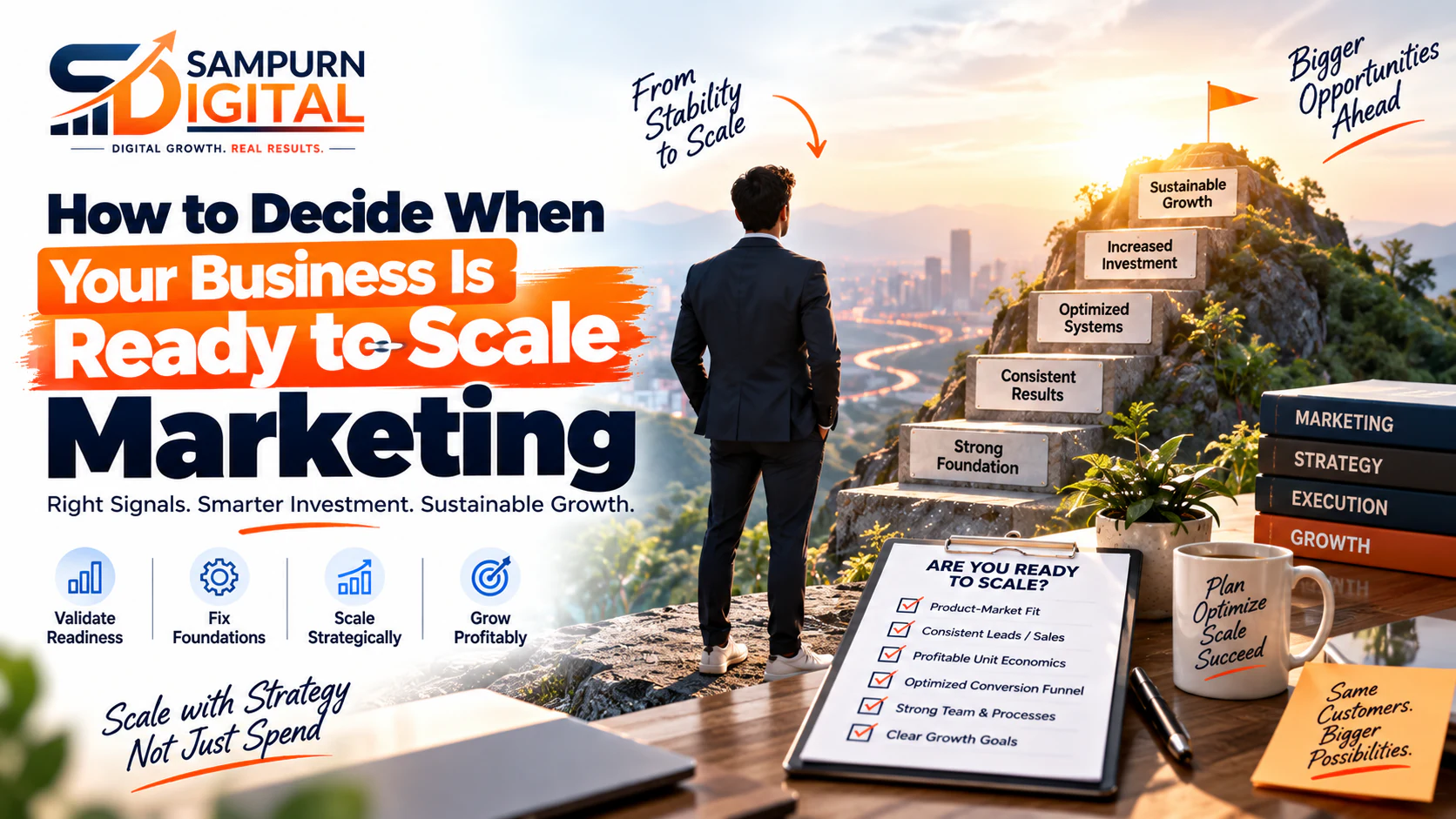
Scaling marketing sounds simple:
Spend more → reach more people → generate more customers.
In reality, increasing marketing investment before the underlying system is ready can make problems more expensive.
You may generate more traffic but not enough customers. You may generate more leads but reduce lead quality. You may increase ad spend while customer acquisition cost rises faster than revenue.
The real question is not:
It is:
This guide explains how to decide when your business is ready to scale marketing, what signals to check first, and how to increase investment without simply increasing waste.
First: Don’t Assume More Budget Will Fix a Growth Problem
A common mistake is trying to solve a marketing problem with a bigger budget.
For example:
But what if the actual problem is:
- Poor targeting
- Weak offer
- Low landing-page conversion
- Poor lead quality
- Broken tracking
- Weak sales follow-up
- High customer acquisition cost
- Insufficient demand
More budget does not automatically fix these problems.
It can simply create more expensive versions of the same problem.
Before scaling, understand how your complete growth funnel works. A useful starting point is [how to improve digital growth funnel](https://www.sampurndigital.com/blog/digital-marketing/the-complete-digital-growth-funnel-from-first-click-to-customer).
Understand What “Scaling Marketing” Actually Means
Scaling is not simply spending more money.
A marketing system is scaling when additional investment can produce additional business growth without proportionally destroying efficiency or quality.
For example:
Scenario A — Not ready
₹1 lakh spend → ₹5 lakh revenue ₹2 lakh spend → ₹7 lakh revenue
Spend doubled, but revenue increased only 40%.
The system may be losing efficiency.
Scenario B — More promising
₹1 lakh spend → ₹5 lakh revenue ₹2 lakh spend → ₹10 lakh revenue
This does not guarantee profitability, but it suggests the system may have additional capacity.
The objective is to discover whether your marketing engine has repeatable growth capacity.
Check Whether Your Core Offer Already Works
Scaling a weak offer is dangerous.
Before increasing marketing investment, ask:
- Are customers buying?
- Is the offer clearly differentiated?
- Is the value proposition understandable?
- Is pricing acceptable to the target audience?
- Are customers satisfied?
- Are sales teams able to explain the offer consistently?
- Are there repeat purchases or referrals where relevant?
If people are consistently exposed to the offer but do not buy, increasing exposure may not solve the problem.
Marketing can create demand and capture demand, but the offer still needs to give customers a reason to act.
If your business is getting traffic but not enough customers, start with [your digital marketing is getting traffic but not enough customers best practices](https://www.sampurndigital.com/blog/digital-marketing/why-your-digital-marketing-is-getting-traffic-but-not-enough-customers).
Confirm That Your Funnel Converts
Before scaling traffic, understand what happens after the click.
A simple funnel might look like:
Suppose you currently have:
- 100,000 visitors
- 3,000 leads
- 300 qualified opportunities
- 60 customers
If you double traffic, the outcome depends heavily on whether those conversion rates remain healthy.
Before scaling, measure:
| Funnel Stage | What to Check |
|---|---|
| Traffic | Are visitors relevant? |
| Landing page | Does it convert? |
| Lead | Are leads qualified? |
| Sales | Do leads become customers? |
| Revenue | Is acquisition profitable? |
If the funnel has major leakage, fix it before pushing more traffic through it.
Check Customer Acquisition Cost
Customer acquisition cost is one of the most important scaling indicators.
A basic formula is:
For example:
₹2,00,000 acquisition spend ÷ 100 new customers \= ₹2,000 CAC
Now ask:
You also need to understand whether CAC changes as you increase spending.
A channel might produce:
- ₹1,500 CAC at ₹50,000 spend
- ₹1,800 CAC at ₹1 lakh spend
- ₹2,700 CAC at ₹2 lakh spend
That suggests the additional audience may be less efficient.
Scaling should therefore evaluate marginal efficiency, not just average efficiency.
Check Lead Quality, Not Just Lead Volume
More leads are not necessarily better.
Imagine:
Before scaling
1,000 leads → 100 sales
After increasing spend
2,000 leads → 110 sales
Lead volume doubled.
Sales increased only 10%.
This is a warning sign.
The additional leads may be:
- Lower intent
- Poorly targeted
- Outside the ideal customer profile
- More price-sensitive
- Less qualified
- Generated by weak promotional messaging
Before scaling, determine whether your current marketing produces the right customers, not simply more contacts.
Check Whether Tracking Is Reliable
You should not scale what you cannot measure properly.
Before increasing investment, verify:
- Conversion tracking
- Analytics
- CRM attribution
- Lead-source tracking
- Revenue tracking
- Advertising platform events
- Form tracking
- Call tracking where applicable
- E-commerce purchase tracking
- UTM governance if your analytics process uses campaign parameters
You need enough confidence in the data to answer:
For businesses managing multiple channels, [SEO strategy and organic search guide](https://www.sampurndigital.com/blog/seo/how-seo-paid-ads-content-and-website-cro-work-together-as-one-growth-system) can help put organic and paid activity into a broader growth-system context.
Check Whether Your Website Can Handle More Traffic
A marketing campaign can succeed while the website becomes the bottleneck.
Before scaling, review:
- Mobile experience
- Page speed
- Landing-page conversion
- Forms
- Checkout
- Navigation
- Technical reliability
- Server capacity
- Analytics implementation
- Conversion tracking
If paid advertising suddenly doubles traffic but the website becomes slow or the lead form fails, marketing efficiency can collapse.
Your website is not just a destination for marketing traffic.
It is part of the acquisition system.
For service businesses, [how conversion-focused web development works](https://www.sampurndigital.com/blog/web-development/lead-generation-website-architecture-for-service-businesses) explains why website architecture matters to lead generation.
Check Whether Your Sales Process Can Handle More Leads
Marketing and sales capacity need to scale together.
Ask:
- How quickly are leads contacted?
- How many leads can the sales team handle?
- What percentage receives a proper follow-up?
- How long is the sales cycle?
- Where are opportunities being lost?
- Can the team handle 2× or 3× current lead volume?
Suppose marketing can generate 500 additional leads next month, but the sales team can properly process only 250.
Increasing marketing spend may create operational waste.
Scaling marketing therefore requires business capacity, not just marketing capacity.
Look for Repeatable Winners
One successful campaign is not necessarily proof that your marketing can scale.
Look for repeatability.
Examples include:
- Multiple successful campaigns
- Consistent conversion rates
- Repeatable SEO traffic growth
- Several profitable audience segments
- Multiple strong creative concepts
- Consistent landing-page performance
- Stable lead quality
- Repeatable sales conversion
The more repeatable the result, the more confidence you can have in increasing investment.
A useful question is:
Understand Channel Capacity
Every marketing channel has a practical limit.
SEO may have additional search demand available.
Paid search may have limited high-intent search volume.
Social advertising may provide broader audience expansion but potentially with lower intent.
Your scaling strategy should therefore consider:
- Audience size
- Search demand
- Competition
- Ad inventory
- Frequency
- Creative fatigue
- Conversion capacity
- Marginal CAC
Do not assume every channel can simply be multiplied by 5.
For paid campaigns specifically, [performance marketing and paid acquisition for businesses](https://www.sampurndigital.com/blog/performance-marketing/when-should-you-increase-your-ad-budget-a-data-based-scaling-framework) provides a more focused framework for deciding when increasing ad budgets makes sense.
Measure Efficiency Before and After Scaling
Create a baseline before increasing investment.
For example:
| Metric | Current | Target After Scaling |
|---|---|---|
| Monthly Spend | ₹2L | ₹2.5L |
| Leads | 500 | 600+ |
| Qualified Leads | 150 | 180+ |
| Customers | 50 | 60+ |
| CAC | ₹4,000 | ≤ ₹4,200 |
| Revenue | ₹8L | ₹9.5L+ |
The goal is not necessarily to keep every metric identical.
Some efficiency loss can happen as you reach less obvious audiences.
The important point is to establish acceptable boundaries before spending more.
Use a Scaling Readiness Scorecard
You can evaluate your business across seven areas.
| Area | Ready? | Key Question |
|---|---|---|
| Offer | Yes / No | Do customers consistently respond? |
| Funnel | Yes / No | Does traffic reliably become customers? |
| CAC | Yes / No | Is acquisition economically sustainable? |
| Lead Quality | Yes / No | Are additional leads commercially useful? |
| Tracking | Yes / No | Can performance be measured accurately? |
| Website | Yes / No | Can the site convert and handle more demand? |
| Sales Capacity | Yes / No | Can the business process additional opportunities? |
Strong readiness
Most areas are stable and supported by reliable data.
Partial readiness
The core system works, but one or two bottlenecks need attention.
Not ready
Multiple fundamental problems remain unresolved.
Do not treat this as a mathematical certification.
It is a decision framework for reducing unnecessary risk.
Don't Scale Everything at Once
A common mistake is increasing:
- SEO investment
- Google Ads
- Meta Ads
- Social content
- Influencer activity
- Website traffic
- Sales hiring
all at the same time.
If performance changes, you may not know why.
Instead, scale in controlled stages.
For example:
Stage 1: Increase investment by 15–20%.
Stage 2: Observe lead quality, CAC, conversion and revenue.
Stage 3: Validate the results.
Stage 4: Increase investment again if the economics remain healthy.
This creates a feedback loop instead of a blind budget increase.
Scale the Strongest Constraint First
Your growth system usually has a bottleneck.
For example:
Strong traffic + weak conversion
Improve the website or offer.
Strong conversion + insufficient traffic
Increase qualified acquisition.
Strong leads + weak sales conversion
Improve sales qualification and follow-up.
Strong revenue + poor profitability
Improve CAC, pricing, margins or channel mix.
Strong paid performance + limited search demand
Explore additional channels and demand creation.
Scaling works best when you identify the current constraint and improve it before simply adding more activity.
Build a Controlled Scaling Plan
A practical scaling plan should define five things:
What are we scaling?
Example:
Google Ads, SEO content, social acquisition, or a complete digital growth program.
How much are we increasing?
Example:
₹1 lakh → ₹1.25 lakh monthly.
What must remain healthy?
Example:
- CAC
- Lead quality
- Conversion rate
- Revenue
- Profitability
When will we evaluate?
Example:
After sufficient performance data has accumulated.
What happens if performance deteriorates?
Define a decision rule before the increase.
For example:
This makes scaling a controlled experiment rather than an emotional decision.
Build a Monthly Scaling Review
Every month, ask:
Growth
- Did traffic increase?
- Did qualified leads increase?
- Did customers increase?
- Did revenue increase?
Efficiency
- Did CAC remain acceptable?
- Did conversion rate remain stable?
- Did channel efficiency change?
Quality
- Did lead quality remain consistent?
- Did sales conversion change?
- Did customer value change?
Capacity
- Can the website handle more demand?
- Can the sales team handle more leads?
- Can marketing production support additional campaigns?
Next decision
Choose one:
This keeps the scaling process disciplined.
Use a Simple Scale / Hold / Fix Framework
At the end of the review, classify each major channel.
| Situation | Decision |
|---|---|
| Strong results + stable economics | Scale |
| Strong results + uncertain capacity | Hold and validate |
| Good traffic + weak conversion | Fix |
| High leads + poor quality | Fix |
| High CAC + weak profitability | Optimize |
| Poor tracking | Fix measurement first |
| Strong performance + limited audience | Diversify |
This is often more useful than simply asking whether a campaign is “performing well.”
When Is Your Business Actually Ready to Scale Marketing?
Your business is more likely to be ready when:
- Your offer consistently attracts customers
- Your funnel is measurable
- Your conversion rates are reasonably stable
- Customer acquisition economics are understood
- Lead quality is acceptable
- Tracking is reliable
- Your website can handle additional demand
- Your sales process can handle more opportunities
- You have repeatable winning channels or campaigns
- You understand channel capacity
- You have defined scaling thresholds
- You know what you will do if performance deteriorates
You do not need perfect performance before scaling.
You need enough evidence that the system is fundamentally working and enough measurement to recognize when scaling begins to create problems.
Final Diagnosis: Scale a Working System, Not a Broken One
The biggest mistake in marketing scaling is confusing more activity with more growth.
A business is not ready to scale simply because:
- It has more budget.
- Traffic is increasing.
- One campaign performed well.
- Competitors are spending more.
- The team wants faster growth.
A stronger signal is a repeatable system where:
works predictably enough to justify additional investment.
Then scaling becomes a controlled process:
If you are unsure whether your business is ready, start by reviewing your funnel, acquisition economics, channel performance, website conversion and sales capacity.
For a complete view of how SEO, paid acquisition, content and website performance can work together, explore [SEO strategy and organic search guide](https://www.sampurndigital.com/blog/seo/how-seo-paid-ads-content-and-website-cro-work-together-as-one-growth-system).
If you want help determining whether your current marketing system is ready for the next stage of growth, get a digital growth consultation with Sampurn Digital.
