
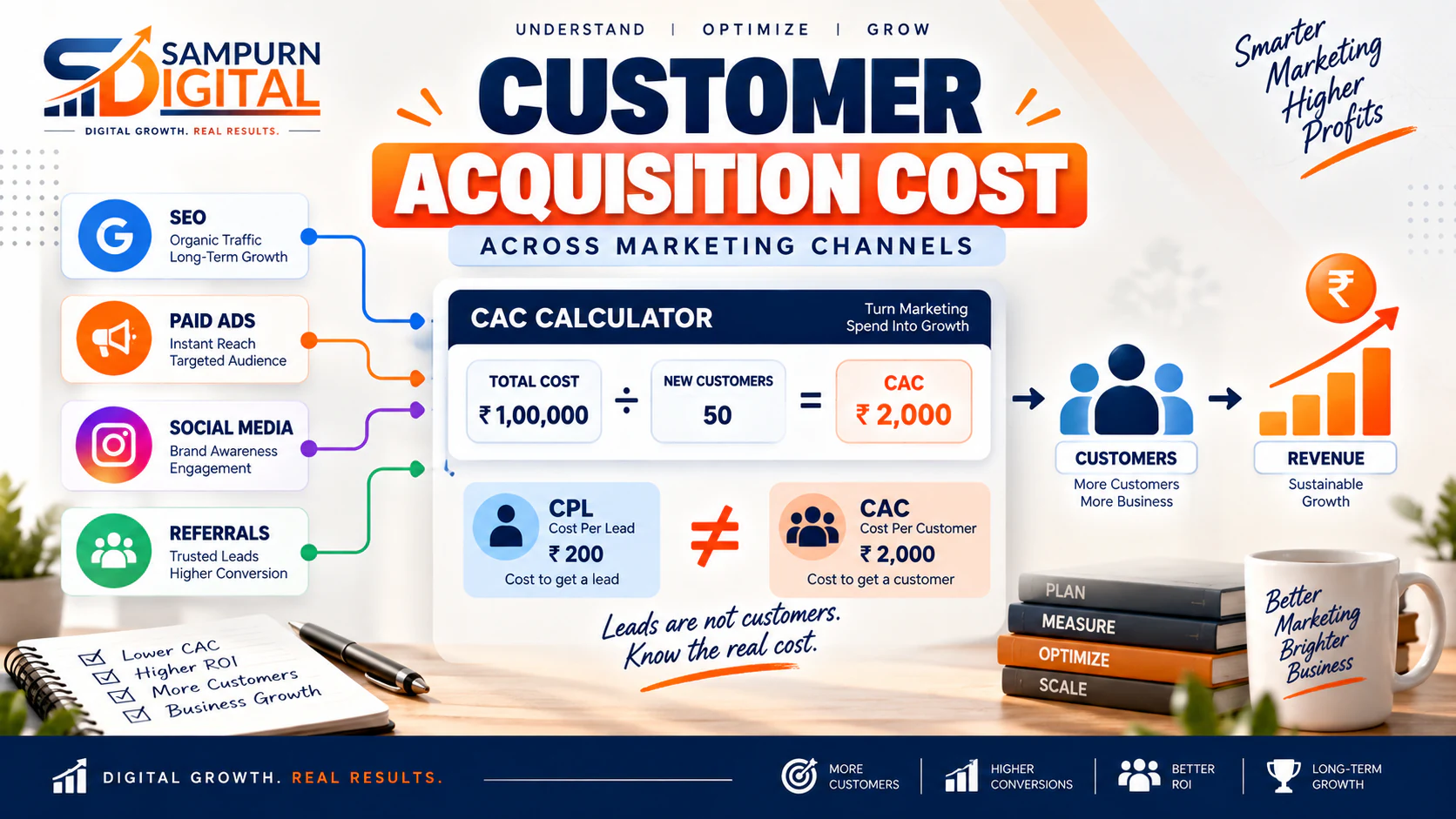
Your marketing generated 500 leads last month.
Sounds good.
But how much did it actually cost to acquire the customers behind those leads?
That's a much more important question.
A business can generate thousands of leads and still have an unhealthy acquisition model.
Another business might generate fewer leads but acquire significantly more customers at a sustainable cost.
This is why customer acquisition cost (CAC) matters.
But there is another problem:
If you only calculate one blended number, you may not know whether:
- SEO is becoming more efficient
- Paid advertising is becoming more expensive
- Social media generates cheap leads but expensive customers
- Referrals are producing high-value customers
- One campaign is consuming budget without producing enough revenue
A useful CAC analysis connects:
This guide explains how to calculate customer acquisition cost across marketing channels and use it to make better marketing decisions.
First: Don't Confuse Cost Per Lead With Customer Acquisition Cost
This is one of the most common marketing measurement mistakes.
Suppose you spend ₹50,000 on advertising.
You generate:
Your cost per lead is:
That sounds efficient.
But suppose only 5 of those leads become customers.
Your actual customer acquisition cost is:
The difference is significant.
A ₹500 lead isn't necessarily cheap if it takes ₹10,000 to acquire a customer.
That's why you should distinguish between:
and
They answer different questions.
What Is Customer Acquisition Cost?
Customer acquisition cost measures how much it costs your business to acquire a new customer.
The basic formula is:
For example:
- Marketing and acquisition cost \= ₹2,00,000
- New customers \= 20
Therefore:
Your average acquisition cost is ₹10,000 per customer.
But this number becomes much more useful when you calculate it by channel.
Why Calculate CAC by Marketing Channel?
Imagine your business spends ₹3,00,000 per month.
You generate customers from:
- SEO
- Google Ads
- Meta Ads
- Social media
- Referrals
- Other sources
If you calculate only blended CAC, you might see:
But that doesn't tell you which channel produced that number.
A channel-level analysis might reveal:
| Channel | Spend | Customers | CAC |
|---|---|---|---|
| SEO | ₹60,000 | 8 | ₹7,500 |
| Google Ads | ₹1,00,000 | 5 | ₹20,000 |
| Meta Ads | ₹80,000 | 3 | ₹26,667 |
| Social | ₹20,000 | 1 | ₹20,000 |
| Other | ₹40,000 | 3 | ₹13,333 |
Now you can ask better questions.
Why is SEO producing customers at ₹7,500?
Why is Meta producing customers at ₹26,667?
Should Google Ads receive more budget?
Should Meta campaigns be improved, reduced or redesigned?
This is the value of channel-level CAC.
The Basic CAC Formula
Start with the simplest version:
But businesses need to define "acquisition cost" consistently.
Depending on your measurement system, this may include:
- Advertising spend
- Agency fees
- Marketing software
- Campaign production
- Sales acquisition costs
- Content production
- Other directly attributable acquisition expenses
The important thing is consistency.
If you include agency costs in one month's calculation but exclude them the next month, your comparison becomes less useful.
Define Your Acquisition Period
Choose a consistent time period.
For example:
- Monthly
- Quarterly
- Yearly
For most active marketing teams, monthly analysis can be useful for operational decisions, while longer periods can provide a more stable view.
Avoid comparing a short period with a long period without considering the difference.
Calculate Total Acquisition Spend
Create a complete list of costs associated with acquiring customers.
For example:
| Cost | Amount |
|---|---|
| Google Ads | ₹80,000 |
| Meta Ads | ₹50,000 |
| SEO | ₹40,000 |
| Content | ₹20,000 |
| Marketing software | ₹10,000 |
| Agency fees | ₹30,000 |
| Total | ₹2,30,000 |
Your total acquisition cost for the period is:
Count New Customers
Next, determine how many new customers were actually acquired during that period.
Suppose:
Then:
Your blended CAC is approximately:
But you're not finished.
Blended CAC is only the starting point.
Assign Customers to Acquisition Channels
Now identify where those customers came from.
Your CRM or analytics system should ideally record the acquisition source.
For example:
| Customer | Primary Source |
|---|---|
| Customer 1 | Organic Search |
| Customer 2 | Google Ads |
| Customer 3 | Referral |
| Customer 4 | Meta Ads |
| Customer 5 | Organic Search |
Do this across your customer base.
The goal is to connect:
Calculate Channel-Level CAC
The basic formula remains the same:
For example:
Google Ads:
- Spend \= ₹80,000
- Customers \= 4
SEO:
- Acquisition cost \= ₹40,000
- Customers \= 8
Now the difference is obvious.
But be careful.
SEO and paid advertising don't always behave identically.
SEO CAC Is Different From Paid CAC
SEO can create value over a longer period.
You may spend money on:
- Strategy
- Content
- Technical SEO
- Optimization
- Link acquisition
- Internal resources
But the resulting traffic may continue generating customers after the original investment.
Paid advertising often has a more direct relationship between spend and immediate acquisition.
This means you should avoid assuming that every channel can be evaluated using exactly the same time horizon.
A useful broader framework is [how SEO, paid ads, content and website CRO work together as one growth system](https://chatgpt.com/blog/seo/how-seo-paid-ads-content-and-website-cro-work-together-as-one-growth-system).
Blended CAC vs Channel CAC
Both metrics are useful.
Blended CAC
It tells you:
"How expensive is customer acquisition overall?"
Channel CAC
It tells you:
"How expensive is acquisition through this particular channel?"
Use blended CAC for overall business economics.
Use channel CAC for marketing decisions.
Don't Judge a Channel by CAC Alone
A lower CAC isn't automatically better.
Suppose:
Channel A
CAC \= ₹5,000
Average customer value \= ₹8,000
Channel B
CAC \= ₹10,000
Average customer value \= ₹50,000
Channel B may be dramatically more valuable despite having a higher CAC.
This is why CAC should be considered alongside customer economics.
Look at:
- Customer lifetime value
- Average order value
- Gross margin
- Repeat purchase rate
- Retention
- Payback period
- Revenue per customer
CAC vs Customer Lifetime Value
A useful comparison is:
where LTV represents the value a customer generates over the relevant customer relationship.
For example:
That may represent a very different business model from:
The same CAC can produce very different outcomes depending on customer value.
Calculate Cost Per Qualified Lead
Customer acquisition isn't the only stage worth measuring.
You can also calculate:
For example:
- Spend \= ₹1,00,000
- Qualified leads \= 20
This is often more useful than cost per raw lead.
A campaign producing 200 low-quality leads may be less valuable than one producing 50 highly qualified prospects.
This connects directly with [why your leads are poor quality and how to diagnose the full funnel](https://chatgpt.com/blog/digital-marketing/why-your-leads-are-poor-quality-a-full-funnel-diagnosis).
Calculate Lead-to-Customer Conversion Rate
Next calculate:
Suppose:
- Leads \= 100
- Customers \= 5
Then:
Now compare channels.
| Channel | Leads | Customers | Conversion Rate |
|---|---|---|---|
| SEO | 50 | 8 | 16% |
| Google Ads | 100 | 5 | 5% |
| Meta Ads | 200 | 4 | 2% |
The lead volume tells only part of the story.
SEO produces fewer leads but converts a higher percentage into customers.
Calculate CAC Using the Full Funnel
A stronger marketing measurement model looks like this:
At each stage, calculate the conversion rate.
For example:
Now you can identify where performance is breaking.
A Simple Channel CAC Example
Suppose your business has three major channels.
SEO
Monthly investment: ₹60,000
Customers: 10
CAC:
Google Ads
Monthly spend: ₹1,00,000
Customers: 5
CAC:
Meta Ads
Monthly spend: ₹80,000
Customers: 4
CAC:
At first glance, SEO appears strongest.
But now examine customer value.
| Channel | CAC | Customers | Avg. Customer Value |
|---|---|---|---|
| SEO | ₹6,000 | 10 | ₹35,000 |
| Google Ads | ₹20,000 | 5 | ₹80,000 |
| Meta Ads | ₹20,000 | 4 | ₹25,000 |
Google Ads has a higher CAC than SEO.
But its customers are significantly more valuable.
Therefore, simply cutting Google Ads because its CAC is higher could be a mistake.
Attribution Makes CAC More Complicated
Customers rarely interact with only one marketing channel.
A typical journey might look like:
Which channel gets credit?
That's an attribution question.
Different attribution models can produce different answers.
This is why channel CAC should be interpreted alongside your attribution model and customer journey.
For a broader view of the journey, see [how customers move from search to social media to your website](https://chatgpt.com/blog/digital-marketing/how-customers-move-from-search-to-social-media-to-your-website).
First-Touch vs Last-Touch Attribution
Two simple approaches are:
First Touch
Credit the first identifiable marketing interaction.
Useful for understanding:
"What introduced this customer to the brand?"
Last Touch
Credit the interaction closest to conversion.
Useful for understanding:
"What channel was closest to the final conversion?"
Neither tells the complete story by itself.
For businesses with longer customer journeys, multi-touch analysis may provide additional context.
Don't Double-Count Marketing Costs
This is a common problem when calculating channel CAC.
Suppose you pay an agency ₹50,000 per month.
You also spend:
- ₹1,00,000 Google Ads
- ₹50,000 Meta Ads
If you simply add the full agency fee to both channels, you've effectively counted the same cost twice.
Instead, establish a consistent allocation method.
For example:
- Allocate based on spend
- Allocate based on hours
- Allocate based on campaigns
- Track channel-specific costs directly
The exact approach depends on how your marketing operation is structured.
Common CAC Calculation Mistakes
Mistake 1: Using Leads Instead of Customers
Leads are not customers.
Use:
in the core CAC formula.
Mistake 2: Ignoring Sales Costs
If sales resources are part of your acquisition model, excluding them may understate acquisition cost.
Mistake 3: Comparing Channels Without Considering Time
SEO and paid advertising may have different investment and return patterns.
Mistake 4: Using Revenue Instead of Profitability
A channel can generate significant revenue while still producing weak economics if margins are low.
Mistake 5: Ignoring Customer Value
A high-CAC channel can still be valuable if it produces high-value customers.
Mistake 6: Trusting Platform-Reported Conversions Blindly
Advertising platforms can report conversions according to their own measurement systems.
Your business-level CRM and revenue data should also be considered.
Mistake 7: Looking Only at the Current Month
Some customer journeys take longer than a few weeks.
Short-term CAC can sometimes look unusually high or low because conversions haven't fully matured.
A Practical CAC Dashboard
A useful weekly or monthly dashboard can include:
| Metric | Overall | SEO | Google Ads | Meta Ads |
|---|---|---|---|---|
| Spend | ₹ | ₹ | ₹ | ₹ |
| Leads | \# | \# | \# | \# |
| Qualified Leads | \# | \# | \# | \# |
| Customers | \# | \# | \# | \# |
| Lead → Customer | % | % | % | % |
| CAC | ₹ | ₹ | ₹ | ₹ |
| Revenue | ₹ | ₹ | ₹ | ₹ |
| Customer Value | ₹ | ₹ | ₹ | ₹ |
This gives you a much clearer view of acquisition performance.
How to Use CAC to Allocate Marketing Budget
Once you understand channel economics, budget decisions become more informed.
Don't simply ask:
"Which channel has the lowest CAC?"
Ask:
Which channels acquire customers?
Which channels acquire qualified customers?
Which channels produce valuable customers?
Which channels can scale?
Which channels are improving or deteriorating?
Where is additional budget likely to produce incremental customers?
This is much closer to a real marketing investment decision.
For broader channel-selection context, see [which marketing channel your business should invest in first](https://chatgpt.com/blog/digital-marketing/which-marketing-channel-should-your-business-invest-in-first).
A Simple CAC Decision Framework
Use this four-step model.
Low CAC + High Customer Value
These channels deserve investigation for additional growth.
High CAC + High Customer Value
The channel may still be strategically valuable.
Low CAC + Low Customer Value
Cheap customers aren't automatically good customers.
High CAC + Low Customer Value
This is usually the highest-priority problem.
When Should CAC Concern You?
There isn't one universal CAC number that works for every business.
Instead, compare CAC against your economics.
Watch for:
- CAC rising consistently
- Customer value falling
- Lead quality declining
- Conversion rates falling
- Paid spend increasing faster than customers
- One channel consuming disproportionate budget
- Longer payback periods
- Revenue growing slower than acquisition costs
A rising CAC isn't automatically a crisis.
It is a signal to investigate.
A Practical Customer Acquisition Cost Audit
If you want to calculate CAC accurately, follow this process.
Step 1
Define what counts as a new customer.
Step 2
Define the acquisition period.
Step 3
List all relevant acquisition costs.
Step 4
Calculate blended CAC.
Step 5
Identify the source of each customer.
Step 6
Calculate channel-level CAC.
Step 7
Calculate qualified-lead rates.
Step 8
Calculate lead-to-customer conversion rates.
Step 9
Compare CAC with customer value.
Step 10
Review attribution and customer journey.
Step 11
Look for trends over multiple periods.
Step 12
Use the findings to inform budget allocation.
Don't Optimize CAC in Isolation
CAC is one piece of the growth equation.
A better model is:
\=
A channel with a higher CAC may still be a strong growth channel.
A channel with a low CAC may still be weak if it produces customers who rarely purchase, churn quickly or generate little margin.
The objective is not:
The objective is:
"Build a sustainable customer acquisition system where acquisition cost makes economic sense."
Final Diagnosis: Know What Each Channel Is Actually Buying
Marketing channels don't simply buy traffic.
They buy opportunities to acquire customers.
That's why the most useful measurement chain is:
If you stop at traffic, you don't know whether marketing is working.
If you stop at leads, you don't know whether lead quality is strong.
If you stop at customers, you still don't know whether those customers are economically valuable.
CAC gives you a way to connect acquisition investment with actual customer growth.
But the strongest analysis goes one step further.
Compare:
Then you can make better decisions about:
- Where to increase investment
- Where to optimize
- Where to reduce waste
- Which channels deserve more attention
- Which channels should not be scaled yet
And most importantly, you stop treating marketing as a traffic-generation exercise.
You start treating it as a customer acquisition system.
