
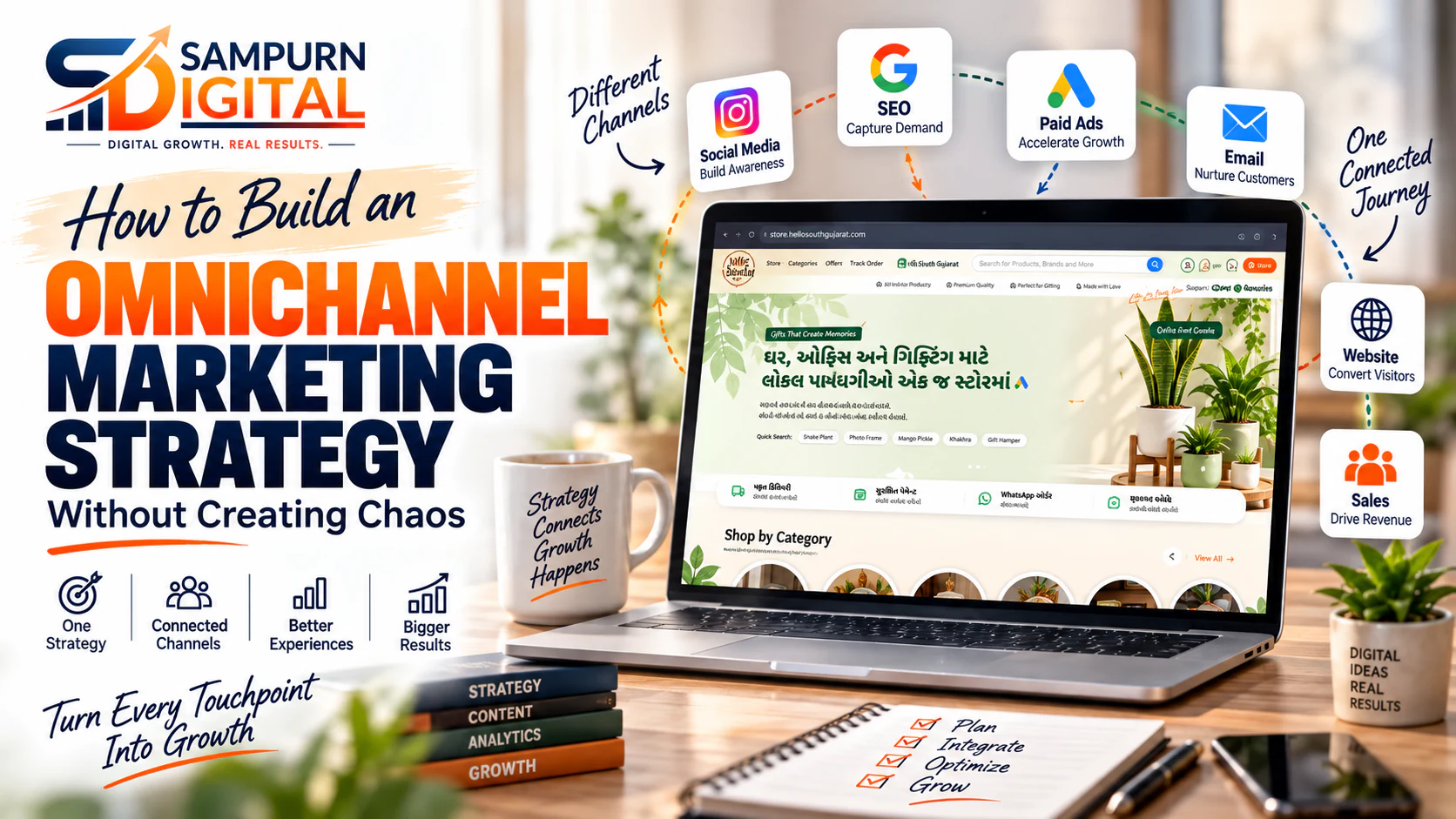
Customers rarely follow a straight marketing path.
Someone may discover your brand through Instagram, search for you on Google a few days later, visit your website, see a retargeting ad, read a review, and finally contact your sales team.
If every channel is managed independently, this journey can quickly become confusing.
The solution is not necessarily to be everywhere.
It is to build an omnichannel marketing strategy where your channels work together, share a common customer journey, and move people toward the same business objective.
The goal is simple:
First: Don't Assume Omnichannel Means Being Everywhere
A common mistake is interpreting omnichannel marketing as:
“We need to be active on every platform.”
That usually creates more complexity, not better marketing.
A strong omnichannel strategy is about coordination, not maximum channel count.
Your SEO, paid advertising, social media, website, content, email, and sales activity should have clear roles.
For example:
When these functions are connected, the customer experiences one brand rather than several disconnected marketing departments.
Start With the Customer Journey
Before choosing channels, map how customers actually move toward a purchase.
A simple journey might be:
At each stage, customers have different questions.
Awareness
“Who are you?”
Consideration
“Can you solve my problem?”
Evaluation
“Why should I choose you?”
Conversion
“Should I contact or buy from you?”
Retention
“Was choosing you the right decision?”
Your channels should support these questions instead of publishing the same message everywhere.
A useful foundation is [how customers move from search to social media to your website](https://www.sampurndigital.com/blog/digital-marketing/how-customers-move-from-search-to-social-media-to-your-website).
Define One Business Goal
Omnichannel marketing becomes chaotic when every channel has a different definition of success.
For example:
- SEO wants more traffic.
- Social wants more followers.
- Paid wants lower CPC.
- Website wants more sessions.
- Sales wants more leads.
These metrics can all improve while revenue stays flat.
Instead, establish a shared business objective.
Examples:
- Generate 500 qualified leads
- Increase e-commerce revenue by 25%
- Reduce customer acquisition cost
- Increase qualified opportunities
- Launch a new product
- Increase repeat purchases
Then connect every channel to that objective.
Give Every Channel a Specific Job
Your omnichannel marketing strategy should define the role of each channel.
| Channel | Primary Role |
|---|---|
| SEO | Capture existing search demand |
| Content | Educate and build authority |
| Social Media | Attention, engagement and demand creation |
| Paid Search | Capture high-intent demand |
| Paid Social | Reach and retarget audiences |
| Website | Convert visitors |
| Email / CRM | Nurture and retain |
| Sales | Convert qualified opportunities |
This prevents channels from competing with each other.
For example, SEO does not need to behave like Instagram.
Paid search does not need to behave like organic social.
Each channel can do what it does best while contributing to the same customer journey.
Your channels need a common understanding of who they are targeting.
Define:
- Ideal customer profile
- Customer problems
- Purchase triggers
- Objections
- Decision criteria
- Awareness level
- Geographic markets
- Product or service interest
Then create audience segments.
For example:
Cold audience
People who do not know your brand.
Engaged audience
People who interacted with your content.
Website visitors
People who have visited important pages.
Leads
People who have submitted information.
Customers
People who already purchased.
High-value customers
Customers with strong lifetime value or repeat-purchase potential.
Each segment can receive a different message.
Create a Message Hierarchy
Your brand should sound consistent without saying exactly the same thing everywhere.
Create three levels of messaging.
Core message
What does your business fundamentally help customers achieve?
Supporting messages
What problems do you solve?
Channel-specific messages
How should that idea be communicated on each platform?
For example:
Core message: Grow revenue through a stronger digital acquisition system.
SEO: Educational content solving specific customer problems.
Social: Short insights, examples and visual explanations.
Paid Ads: Clear problem + value proposition + action.
Website: Detailed proof, services, benefits and conversion paths.
Consistency should exist in meaning, not necessarily identical wording.
Connect SEO, Social and Paid Content
One of the biggest opportunities in omnichannel marketing is content reuse.
A single strong business topic can become:
This creates consistency while reducing production effort.
For example, a blog about reducing customer acquisition cost could become:
- Search-optimized article
- Short-form video
- Social carousel
- Paid-ad concept
- Email newsletter
- Sales presentation section
This is much more efficient than creating every channel's content from scratch.
Build Channel-to-Channel Journeys
Do not think only in terms of individual channels.
Think about transitions.
Examples:
Social → Website
A social post introduces a problem and sends interested users to a useful resource.
Search → Website → Retargeting
A user finds an SEO article, visits the site, leaves, and later receives a relevant remarketing message.
Paid Ad → Landing Page → Lead → Sales
An advertisement captures high-intent demand and sends the visitor to a focused conversion page.
Content → Email → Offer
Educational content builds interest before a relevant offer is introduced.
These transitions are what make an omnichannel strategy different from simply running multiple channels.
Make the Website the Conversion Hub
Your website often sits in the middle of the omnichannel system.
Traffic may arrive from:
- YouTube
- Paid ads
- Direct traffic
- Referrals
The website should give each audience a logical next step.
Depending on intent, that could be:
- Read an article
- View a service
- Compare solutions
- Download a resource
- Request a consultation
- Start a purchase
- Contact sales
A strong website should connect acquisition to conversion.
For service businesses, [how conversion-focused web development works](https://www.sampurndigital.com/blog/web-development/lead-generation-website-architecture-for-service-businesses) provides a useful framework for building this foundation.
Use Retargeting Based on Behaviour
Not every visitor should see the same follow-up message.
Someone who viewed your homepage is different from someone who:
- Read three articles
- Viewed pricing
- Visited a service page
- Started checkout
- Added a product to cart
- Submitted a lead form
Create audiences based on meaningful behaviour.
For example:
This makes retargeting more relevant and reduces unnecessary repetition.
Avoid Channel Conflict
Omnichannel marketing can create problems when channels compete for the same audience without coordination.
Examples:
- Paid ads promoting an expired offer
- Website showing different pricing from social
- Sales team using an outdated offer
- Email promoting a product that is unavailable
- Social promising something the landing page does not explain
Create a shared campaign calendar.
Every major campaign should define:
- Campaign name
- Audience
- Objective
- Offer
- Core message
- Start date
- End date
- Channels
- Landing page
- Conversion event
- Owner
This creates one source of truth.
Build an Omnichannel Campaign Brief
Before launching a campaign, document the strategy.
Campaign Objective
What business outcome are we trying to create?
Audience
Who is this campaign targeting?
Problem
What customer problem are we addressing?
Offer
What are we asking people to consider?
Message
What should the audience understand?
Channels
Where will the campaign appear?
Journey
What happens after someone interacts?
Conversion
What counts as success?
Measurement
Which metrics will determine performance?
This prevents each channel team from interpreting the campaign differently.
Your channels can have different operational KPIs, but the business should have shared outcome metrics.
Channel metrics
SEO:
- Organic clicks
- Rankings
- Organic conversions
Paid:
- Spend
- CPC
- Conversion rate
- CAC
- ROAS
Social:
- Reach
- Engagement
- Traffic
- Leads
Website:
- Conversion rate
- Leads
- Sales
- Revenue
Business metrics
Across all channels:
- Qualified leads
- Customers
- Revenue
- CAC
- ROI
- Customer lifetime value
This prevents teams from optimizing individual channel metrics at the expense of business performance.
Understand Attribution Without Expecting Perfect Answers
Customers often interact with multiple channels before converting.
For example:
Which channel generated the customer?
The honest answer may be:
Do not force every customer into a simplistic single-channel attribution model.
Instead, analyze:
- First interaction
- Assisted interactions
- Last interaction
- Conversion path
- Revenue contribution
The objective is to understand the customer journey well enough to make better investment decisions.
Use One Campaign Calendar Across Teams
Create a shared calendar showing major marketing activity.
| Campaign | SEO | Paid | Social | Website | Sales |
|---|---|---|---|---|---|
| Product Launch | Content | Ads | Launch posts | Landing page | Outreach |
| Seasonal Offer | SEO page | Search + Social | Promotion | Offer page | Follow-up |
| Lead Generation | Guide | Lead ads | Content | Lead page | Qualification |
This allows teams to see what other channels are doing.
It also reduces duplicate work.
Scale What Works Across Channels
A strong omnichannel system creates a feedback loop.
For example:
This is how channels can improve each other instead of operating independently.
Don't Fix Everything at Once
If your current marketing is fragmented, do not attempt to rebuild every channel simultaneously.
Start with the biggest coordination problems.
A practical priority order is:
Priority 1: Customer journey
Understand how customers discover, evaluate and convert.
Priority 2: Shared messaging
Create a consistent value proposition.
Priority 3: Website
Make sure traffic has a clear conversion path.
Priority 4: Measurement
Connect channel performance to business outcomes.
Priority 5: Campaign coordination
Create shared briefs and calendars.
Priority 6: Optimization
Improve individual channels after the system is connected.
This reduces unnecessary complexity.
Use the Omnichannel Readiness Checklist
Before calling your strategy omnichannel, check:
Strategy
- Business objective is clearly defined
- Customer journey is documented
- Target audiences are defined
- Channel roles are clear
Messaging
- Core value proposition is consistent
- Offers are aligned across channels
- Campaign messaging is documented
Channels
- SEO supports demand capture
- Social supports awareness and engagement
- Paid supports acquisition and/or retargeting
- Website supports conversion
- CRM/email supports nurturing and retention
Operations
- Shared campaign calendar exists
- Campaign owners are assigned
- Landing pages are ready
- Sales knows the campaign offer
- Teams have access to current messaging
Measurement
- Conversion tracking is reliable
- Channel KPIs are defined
- Business KPIs are defined
- Customer journeys can be analyzed
- Revenue impact is reviewed
Know When Your Omnichannel Strategy Is Becoming Chaotic
Watch for these warning signs:
- Every channel has a different strategy.
- Teams use different audience definitions.
- Customers receive repetitive messages.
- Offers are inconsistent.
- Campaigns launch without shared planning.
- Nobody owns the customer journey.
- Reporting focuses entirely on channel metrics.
- The website does not match advertising.
- Sales is disconnected from marketing.
- Teams create content without knowing what other teams are producing.
If several of these are happening, adding more channels is unlikely to solve the problem.
You need better coordination first.
Final Diagnosis: Omnichannel Marketing Should Feel Connected, Not Complicated
An effective omnichannel marketing strategy does not require your business to dominate every platform.
It requires your important channels to work together.
The system should look something like:
And the internal operating system should look like:
The purpose is not to create more marketing activity.
It is to create a better customer journey.
If your business is currently generating traffic but struggling to convert that attention into customers, start by reviewing [how to improve your digital marketing is getting traffic but not enough customers](https://www.sampurndigital.com/blog/digital-marketing/why-your-digital-marketing-is-getting-traffic-but-not-enough-customers).
For businesses ready to connect SEO, paid advertising, social media and website performance into one coordinated growth system, get a digital growth consultation with Sampurn Digital.
