
c
Define What a Good Lead Looks Like
Before generating leads, define who you actually want.
A qualified lead might be based on:
- Industry
- Company size
- Location
- Budget
- Business model
- Service requirement
- Purchase timeline
- Decision-making authority
- Existing problem
- Fit with your service
For example, a digital marketing agency may decide that its ideal lead is:
A growing business with an established website, an active marketing budget and a clear need to improve customer acquisition.
That definition immediately influences:
- Keywords
- Content
- Advertising
- Social media
- Offers
- Landing pages
- Lead forms
Without an ideal customer definition, lead generation tends to become a volume game.
Identify the Problem You Are Solving
People rarely search for a service simply because the service exists.
They search because they have a problem.
A business may need:
- More qualified enquiries
- Lower customer acquisition cost
- Better organic visibility
- More website conversions
- Better paid advertising performance
- A stronger online presence
Instead of starting with:
“We provide digital marketing.”
Start with:
“We help businesses turn fragmented digital marketing activity into a measurable lead generation system.”
The second statement is closer to the customer's desired outcome.
Define the Lead Generation Offer
Your system needs a reason for someone to take the next step.
That could be:
- Free consultation
- Strategy session
- Audit
- Assessment
- Demo
- Quote
- Trial
- Download
- Case study
- Calculator
- Checklist
The offer should match the customer's buying stage.
Someone researching a problem may want a useful guide.
Someone comparing solutions may want a consultation.
Someone ready to hire may want a proposal or quote.
A strong lead generation system does not force every visitor into the same CTA.
Build the Funnel Before Buying Traffic
Before spending money on advertising, map the journey.
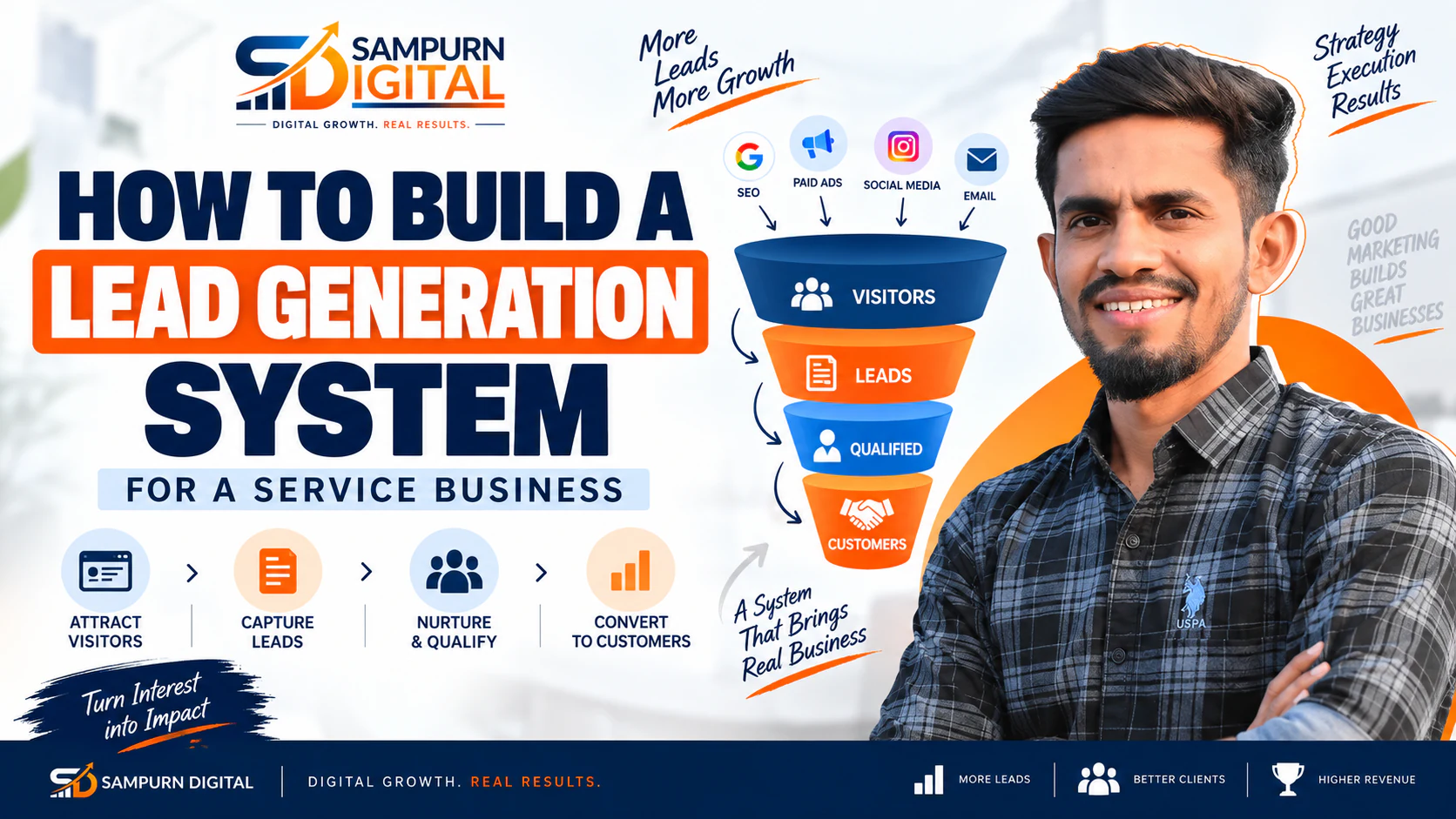
A basic service-business funnel can look like:
Educational content / social media / search
Case studies / service pages / guides
Consultation / enquiry / demo
Sales conversation
If you need a broader framework for how customers move through these stages, start with [a practical digital growth funnel guide](https://chatgpt.com/blog/digital-marketing/the-complete-digital-growth-funnel-from-first-click-to-customer).
The funnel gives every marketing channel a job.
Use SEO to Capture Existing Demand
SEO can become a long-term source of qualified leads for service businesses.
But the goal should not be:
“Rank for as many keywords as possible.”
Instead, target searches connected to customer problems and commercial intent.
For example, a service business could create:
Problem-focused content
Why are my website visitors not becoming leads?
Solution-focused content
How to improve website conversion rate
Commercial content
Conversion optimization services
Decision-stage content
SEO agency vs in-house SEO team
This creates multiple entry points into the lead generation system.
A strong SEO content strategy should connect topics to customer journeys, which is why [SEO strategy and organic search for businesses](https://chatgpt.com/blog/seo/how-to-turn-a-page-that-ranks-into-a-page-that-generates-leads) can be useful when turning organic traffic into enquiries.
Use Paid Advertising to Capture High-Intent Demand
Paid advertising can accelerate lead generation when the targeting, offer and conversion path are aligned.
For service businesses, campaigns might target:
- Service-specific searches
- Problem-specific searches
- Location-specific searches
- Competitor alternatives
- Retargeting audiences
- High-intent social audiences
But paid traffic should not simply be sent to a generic homepage.
The journey should be intentional:
For campaigns that need structured experimentation, [performance marketing and paid acquisition guide](https://chatgpt.com/blog/performance-marketing/ab-testing-ads-vs-landing-pages-what-should-you-test-first) can help when deciding what to test across ads and landing pages.
Build a Website That Supports Lead Generation
Your website is not just a company brochure.
It is part of the acquisition system.
A service-business website should make it easy for visitors to understand:
- What you do
- Who you help
- What problem you solve
- Why they should trust you
- What makes your approach different
- What happens next
Important conversion elements can include:
- Clear value proposition
- Relevant service pages
- Case studies
- Testimonials
- FAQs
- Strong CTAs
- Short forms
- Contact options
- Trust signals
The architecture also matters.
For a deeper framework, see [how conversion-focused web development works](https://chatgpt.com/blog/web-development/lead-generation-website-architecture-for-service-businesses).
Create Dedicated Landing Pages
Not every campaign should send visitors to the homepage.
Suppose the campaign promotes:
Performance marketing services for ecommerce businesses.
The landing page should be built around that exact audience and problem.
It can include:
- Specific headline
- Relevant benefits
- Service explanation
- Proof
- Process
- FAQs
- CTA
- Qualification form
This creates continuity between the marketing message and the conversion experience.
Keep the Lead Form Simple
A form should collect enough information to qualify the lead without creating unnecessary friction.
Possible fields include:
- Name
- Business name
- Phone
- Website
- Service required
- Monthly marketing budget
- Business goals
- Message
But do not automatically ask for everything.
Ask:
Which information is actually needed to determine whether this lead is worth pursuing?
For a high-value B2B service, more qualification may make sense.
For a lower-friction offer, a shorter form may perform better.
Create a Lead Qualification System
Generating a lead is only the beginning.
You need to determine whether the lead is:
Unqualified
Does not match your service or target customer.
Marketing Qualified
Shows meaningful interest and appears relevant.
Sales Qualified
Has a clear need, fit and potential buying intent.
Opportunity
Has entered an active sales process.
This classification helps sales and marketing understand what is actually happening after form submission.
Score Leads Based on Business Fit
A simple scoring model can make lead management more systematic.
For example:
| Factor | Example Score |
|---|---|
| Fits target industry | +10 |
| Required service matches | +15 |
| Has active budget | +20 |
| Decision-maker | +15 |
| Urgent requirement | +15 |
| Website/business established | +10 |
| Outside target geography | \-10 |
| No clear business need | \-15 |
The exact scoring system should be customized to the business.
The purpose is not mathematical perfection.
The purpose is to help the team prioritize.
Connect Lead Generation With Sales Follow-Up
A lead generation system fails if leads are collected but nobody follows up properly.
Define:
- Who receives the lead
- How quickly they respond
- What happens after submission
- How many follow-ups occur
- Which leads require immediate calls
- When a lead is marked inactive
- How sales outcomes are reported back to marketing
For example:
Now marketing is connected to revenue.
Track Lead Quality, Not Just Lead Count
Your dashboard should not stop at:
100 leads generated.
Track the full sequence.
For example:
| Stage | Number |
|---|---|
| Website visitors | 10,000 |
| Leads | 400 |
| Qualified leads | 120 |
| Sales opportunities | 50 |
| Proposals | 30 |
| Customers | 12 |
| Revenue | ₹X |
Now you can identify where the system is losing value.
If traffic is high but leads are low, investigate conversion.
If leads are high but qualified leads are low, investigate targeting.
If qualified leads are high but sales are low, investigate sales follow-up, pricing or offer fit.
This is far more useful than reporting traffic alone.
Create Different Content for Different Funnel Stages
Your lead generation system should not rely on one type of content.
Awareness content
Answers questions and identifies problems.
Examples:
- Guides
- Educational blogs
- Social posts
- Videos
Consideration content
Helps customers evaluate solutions.
Examples:
- Comparisons
- Case studies
- Frameworks
- Webinars
Decision content
Helps customers choose your business.
Examples:
- Service pages
- Pricing information
- Testimonials
- Consultation offers
- Proposals
This creates a more complete journey.
Use Retargeting to Recover Lost Visitors
Many potential customers will not convert on their first visit.
They may:
- Need more information
- Compare competitors
- Discuss the purchase internally
- Wait for budget approval
- Simply forget
Retargeting can bring these visitors back with more relevant messaging.
For example:
Learn why your website traffic isn't converting.
Ready to identify where your conversion funnel is losing leads?
The message can become progressively more action-oriented as the prospect moves closer to a decision.
Create a Lead Nurturing Process
Not every qualified prospect is ready to buy immediately.
A nurturing system can provide:
- Educational content
- Case studies
- Service information
- FAQs
- Industry insights
- Follow-up emails
- Consultation invitations
The objective is not to send endless emails.
It is to remain useful while the prospect moves toward a decision.
Connect Marketing and Sales Data
One of the biggest gaps in service businesses is the separation between marketing and sales.
Marketing sees:
250 leads.
Sales sees:
Only 40 were worth contacting.
Neither team has the complete picture.
Connect the data.
Track:
Then you can answer questions such as:
- Which channel generates the best customers?
- Which campaign generates the highest-quality leads?
- Which landing page produces better opportunities?
- Which service has the strongest demand?
- Which source creates the highest revenue?
This turns lead generation into a measurable business system.
Diagnose the System When Leads Are Weak
When lead generation performance drops, do not immediately increase advertising spend.
Use a diagnostic chain:
Traffic problem
Not enough relevant visitors.
Targeting problem
Visitors do not match the ideal customer.
Offer problem
There is no compelling reason to respond.
Landing-page problem
The visitor does not understand or trust the offer.
Conversion problem
The form or CTA creates unnecessary friction.
Qualification problem
Too many irrelevant leads are entering.
Sales problem
Good leads are not becoming customers.
This approach prevents the business from treating every problem as a traffic problem.
For the broader issue of traffic without enough customers, see [how to improve your digital marketing is getting traffic but not enough customers](https://chatgpt.com/blog/digital-marketing/why-your-digital-marketing-is-getting-traffic-but-not-enough-customers).
Decide Which Channel Should Do What
You do not need every channel to perform the same function.
For example:
| Channel | Primary Role |
|---|---|
| SEO | Capture organic demand |
| Google Ads | Capture high-intent demand |
| Social Media | Build awareness and trust |
| Retargeting | Re-engage visitors |
| Website | Convert traffic |
| Nurture prospects | |
| Sales | Qualify and close |
This is more effective than simply saying:
“Every channel needs to generate leads.”
The channels should work together.
For a broader channel allocation framework, see [which marketing channel should your business invest in first explained for businesses](https://chatgpt.com/blog/digital-marketing/which-marketing-channel-should-your-business-invest-in-first).
Build the System Around One Clear Conversion Path
A service business does not need ten competing CTAs on every page.
Choose the primary action.
For example:
Book a Digital Growth Consultation
Secondary actions can support visitors who are not ready.
For example:
- Read a guide
- View case studies
- Explore services
- Download a checklist
The goal is to create a clear hierarchy.
Don't Fix Everything at Once
If your lead generation system is underperforming, avoid changing every component simultaneously.
Prioritize the highest-impact issue.
Check lead quality
Are the right people entering?
Check conversion rate
Are relevant visitors taking action?
Check offer
Is there a strong reason to respond?
Check landing page
Does the page match the campaign?
Check follow-up
Are leads being contacted effectively?
Check sales conversion
Are qualified opportunities becoming customers?
This creates a much clearer optimization process.
A Practical Lead Generation System Framework
Use this framework when building a system from scratch.
Stage 1 — Define
- Ideal customer
- Customer problem
- Desired outcome
- Service
- Offer
- Conversion goal
Stage 2 — Attract
- SEO
- Paid search
- Social media
- Content
- Referrals
- Other relevant channels
Stage 3 — Convert
- Landing page
- Service page
- CTA
- Form
- Booking system
Stage 4 — Qualify
- Lead scoring
- Qualification questions
- CRM stages
- Sales notifications
Stage 5 — Nurture
- Retargeting
- Case studies
- Educational content
- Follow-up
Stage 6 — Close
- Sales call
- Proposal
- Negotiation
- Agreement
Stage 7 — Measure
- Leads
- Qualified leads
- Opportunities
- Customers
- CAC
- Revenue
This turns lead generation from a campaign into an operating system.
Service Business Lead Generation Checklist
Before considering your system ready, check:
- Ideal customer is clearly defined
- Customer problem is documented
- Service positioning is clear
- Lead-generation offer is specific
- Funnel stages are mapped
- SEO opportunities are identified
- Paid acquisition opportunities are identified
- Social media has a defined role
- Website supports conversion
- Landing pages match campaigns
- Forms collect useful qualification information
- Leads enter a defined process
- Lead scoring or qualification exists
- Sales receives leads quickly
- Follow-up process is documented
- Lead nurturing exists
- Retargeting is considered
- Marketing and sales data are connected
- Lead quality is measured
- Customer acquisition cost is tracked
- Revenue is connected back to marketing sources
Final Diagnosis: Lead Generation Is a System, Not a Form
A contact form does not create a lead generation system.
Neither does Google Ads.
Neither does SEO.
Neither does social media.
A reliable service-business acquisition system connects all of them.
The complete journey looks like:
The biggest improvement often comes not from adding another channel, but from fixing the connection between the channels you already have.
If you can consistently identify the right audience, attract relevant demand, convert visitors, qualify prospects and connect those leads to sales outcomes, your marketing becomes much more predictable.
And once the system is built, the next question is not simply:
“How can we get more leads?”
It becomes:
“How can we improve the quality, conversion rate and revenue generated by every stage of the system?”
That is where sustainable digital growth begins.
