
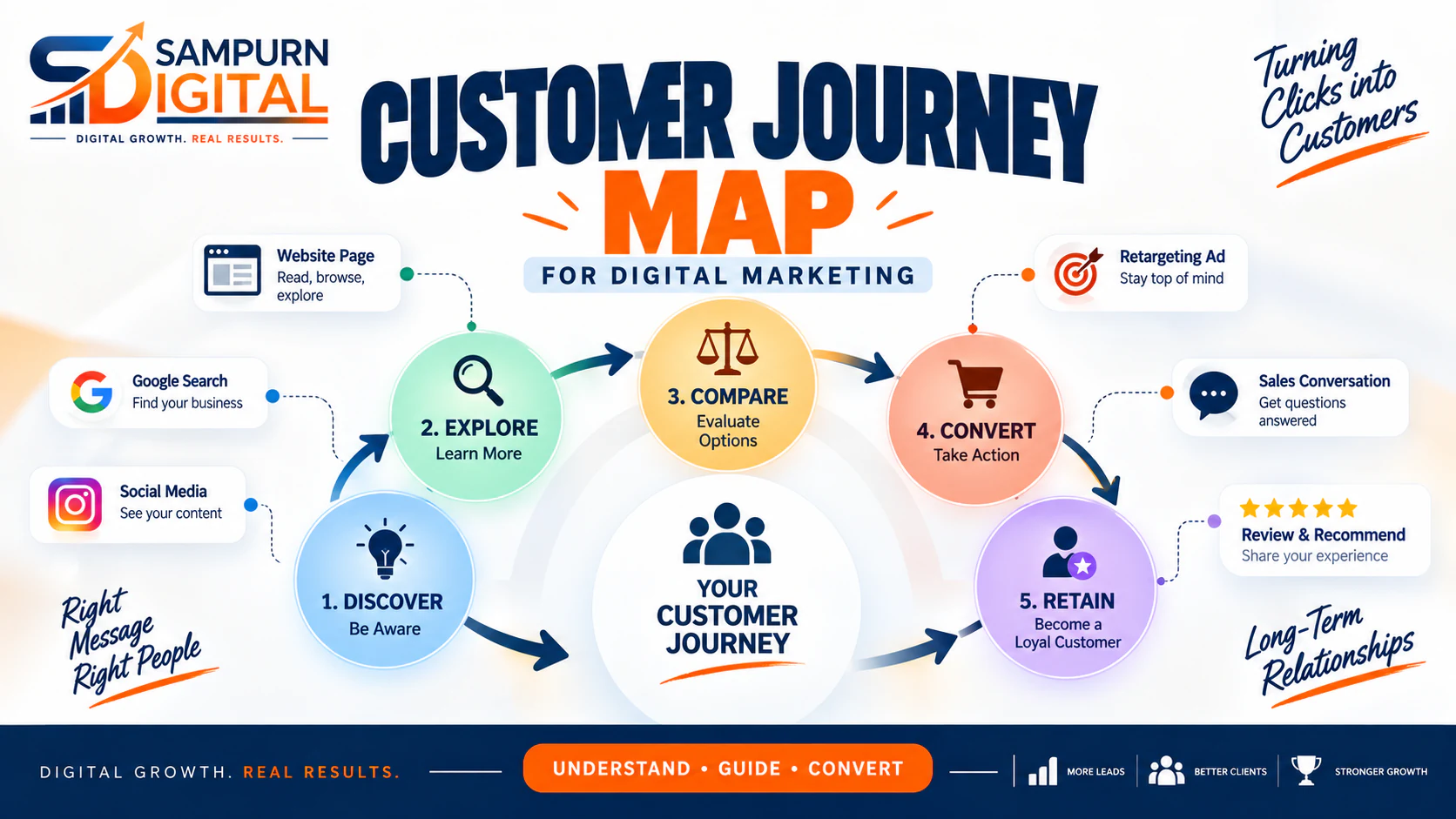
Your customers rarely move from “I need this” to “I bought this” in one step.
They may discover your business through Google, see your Instagram content later, visit your website, compare alternatives, leave, return through an ad, and finally become a customer after several interactions.
If your marketing treats every channel as a separate activity, it becomes difficult to understand what the customer is actually experiencing.
That is where a customer journey map for digital marketing becomes useful.
A customer journey map helps you visualize the path from the first interaction to conversion and identify what should happen at each stage.
But the goal isn't to create a complicated diagram.
The goal is to answer a much more practical question:
What does the customer need at each stage, and how should our marketing help them move forward?
First: Don't Map Channels. Map the Customer.
One of the biggest mistakes businesses make is creating a journey map that looks like this:
That is a channel map.
It doesn't necessarily represent how customers behave.
A real customer journey may look more like:
Reads an educational article
Visits Instagram
Follows the brand
Sees a retargeting ad
Visits a service page
Compares alternatives
Returns through branded search
Fills out a form
Becomes a customer
The same customer may interact with several channels before taking action.
So your journey map should begin with customer behaviour, not your marketing department's channel structure.
Start With the Customer's Problem
Before mapping touchpoints, define what causes the journey to begin.
Customers don't usually start by thinking:
"I want to engage with this company's digital marketing funnel."
They start with a problem, goal, question or desire.
For example:
A business owner may think:
"My website gets traffic, but I'm not getting enough leads."
That problem could lead them to search for:
- why website traffic isn't converting
- how to improve website conversions
- digital marketing services
- lead generation strategies
- SEO and conversion optimization
The journey starts with the problem, not the keyword.
This distinction matters because your marketing needs to address the customer's situation at each stage.
Define the Main Customer Journey Stages
A practical digital customer journey can be divided into five stages:
Stage 1: Awareness
The customer becomes aware of a problem, need or opportunity.
They may:
- search on Google
- see a social media post
- watch a video
- hear about your business
- discover your brand through another website
The customer's question is usually:
"What is happening?"
Your marketing should help them understand the problem.
Stage 2: Consideration
The customer understands the problem and starts evaluating possible solutions.
They may:
- read detailed articles
- compare providers
- visit service pages
- watch demonstrations
- read reviews
- follow competitors
- compare pricing or features
The question becomes:
"What are my options?"
Your content should help them evaluate those options.
Stage 3: Evaluation
Now the customer is actively comparing specific solutions.
They may ask:
- Which provider is better?
- Which approach should I use?
- What will this cost?
- Can this company solve my specific problem?
- Do they have relevant experience?
- What happens after I contact them?
At this stage, generic awareness content is no longer enough.
The customer needs evidence, clarity and confidence.
Stage 4: Conversion
The customer is ready to take an action.
That could be:
- requesting a consultation
- submitting a form
- calling the business
- booking a meeting
- starting a trial
- purchasing a product
The marketing job here is to reduce friction.
The customer should understand:
Stage 5: Retention and Expansion
The journey doesn't necessarily end after the first purchase.
Customers may:
- return to the website
- purchase again
- upgrade
- refer someone
- engage with content
- become long-term clients
A strong digital marketing system therefore considers what happens after conversion as well.
Create a Customer Journey Map Framework
Now you can build the actual map.
A simple framework is:
| Journey Stage | Customer Question | Customer Action | Touchpoint | Content | Business Goal |
|---|---|---|---|---|---|
| Awareness | What is my problem? | Searches | Educational content | Generate awareness | |
| Consideration | What are my options? | Researches | Website/Social | Guides, comparisons | Build trust |
| Evaluation | Which solution should I choose? | Compares | Website/Ads | Case studies, service pages | Create preference |
| Conversion | Can I trust this provider? | Contacts/buys | Landing page | Offer + proof | Generate conversion |
| Retention | What should I do next? | Returns | Email/Website/Social | Support and education | Increase lifetime value |
This gives you a much more useful view than simply listing your marketing channels.
Identify Every Important Customer Touchpoint
A marketing touchpoint map should include the places where customers interact with your business.
These may include:
Search
- Google search results
- blog articles
- service pages
- local search listings
Social Media
- Instagram posts
- Reels
- LinkedIn content
- social ads
- comments
- direct messages
Website
- homepage
- service pages
- landing pages
- product pages
- contact pages
- lead forms
Paid Advertising
- Google Ads
- Meta Ads
- remarketing campaigns
- display campaigns
Direct Communication
- sales calls
- consultation meetings
Post-Conversion
- onboarding
- support
- email follow-ups
- customer education
- remarketing
The objective is not to include every possible interaction.
Focus on the touchpoints that can materially influence the customer's decision.
Understand Search Intent at Each Stage
Different journey stages often involve different types of searches.
For example:
Awareness
A customer might search:
"Why is my website traffic not converting?"
This is primarily a problem-focused query.
Consideration
They may search:
"How to improve website conversion rate"
Now they are investigating solutions.
Evaluation
They may search:
"digital marketing agency for lead generation"
Now they are closer to choosing a provider.
Conversion
They may search:
"Sampurn Digital digital marketing services"
The customer is now interacting with a specific brand.
This is why your content should not target only one type of keyword.
Your journey should connect problems → solutions → evaluation → action.
For businesses building an SEO-led customer journey, it can also help to connect the journey to a structured [SEO content calendar around customer journeys](https://www.sampurndigital.com/blog/seo/how-to-build-an-seo-content-calendar-around-customer-journeys).
Map the Customer's Questions
One of the easiest ways to build a useful customer journey framework is to list the questions customers ask at every stage.
For example:
Awareness Questions
- What is wrong?
- Why is this happening?
- Do I actually have this problem?
- How serious is it?
Consideration Questions
- What solutions are available?
- Which approach makes sense?
- What are the advantages and disadvantages?
- What should I compare?
Evaluation Questions
- Which provider should I choose?
- How much will it cost?
- What results are realistic?
- Can this provider solve my specific problem?
Conversion Questions
- What happens if I contact you?
- How quickly can we start?
- What information do you need?
- What is the next step?
Retention Questions
- What happens after purchase?
- How do I get more value?
- What should I do next?
- Can I expand the relationship?
Your content should answer these questions instead of simply filling a publishing calendar.
Connect Content to the Journey
Every important piece of content should have a job.
For example:
Explains the customer's problem
Explains possible solutions
Helps evaluate alternatives
Explains your solution
Builds confidence
Creates the conversion opportunity
This creates a connected content system rather than a collection of unrelated blog posts.
For example, if someone is trying to understand the complete journey from discovery to purchase, your [digital growth funnel guide](https://www.sampurndigital.com/blog/digital-marketing/the-complete-digital-growth-funnel-from-first-click-to-customer) can provide the broader funnel context.
Connect Search, Social and Website Experiences
A customer journey becomes much stronger when channels support each other.
Consider this example.
A customer searches Google for a problem.
They discover your article.
The article explains the problem and introduces a possible solution.
The customer later sees your social media content.
That content reinforces the same idea.
They visit your website.
The website provides deeper information and a relevant service.
Later, they see a remarketing advertisement.
They return and convert.
Each interaction has a different job.
The channels are not competing.
They are continuing the same customer journey.
This is why understanding [how customers move from search to social media to your website](https://www.sampurndigital.com/blog/digital-marketing/how-customers-move-from-search-to-social-media-to-your-website) is important when designing a cross-channel marketing system.
Identify Journey Gaps
Once the map is built, look for missing steps.
For example:
Problem
You generate strong awareness traffic.
But
There is no useful consideration content.
Result
Visitors leave before understanding your solution.
Another example:
Problem
Your social content generates engagement.
But
There is no clear path to the website.
Result
Attention doesn't become measurable business activity.
Another:
Problem
Your website gets qualified traffic.
But
The service page doesn't provide enough proof.
Result
Visitors hesitate to contact you.
These gaps are often more important than simply creating more content.
Find the Broken Handoffs
A customer journey isn't only about individual touchpoints.
It is also about the handoffs between them.
For example:
Does the landing page answer the searcher's question?
Does the social content give people a relevant reason to visit?
Does the landing page match the promise made in the advertisement?
Does the article naturally introduce the next relevant solution?
Does the sales process continue the same message established during marketing?
These transitions can create major friction.
A customer may be interested but still fail to move forward because the next step feels disconnected.
Assign a Business Goal to Every Stage
A customer journey should eventually connect to business outcomes.
For example:
| Stage | Primary Goal | Useful Measurement |
|---|---|---|
| Awareness | Generate relevant visibility | Impressions, reach, new visitors |
| Consideration | Build engagement and trust | Engaged sessions, content engagement |
| Evaluation | Create buying intent | Service views, enquiries, remarketing engagement |
| Conversion | Generate customers | Leads, purchases, booked calls |
| Retention | Increase customer value | Repeat purchases, renewals, referrals |
This prevents the journey map from becoming a purely theoretical marketing document.
The purpose is not to create a beautiful diagram.
The purpose is to understand where marketing contributes to growth.
Build Customer Personas Around Real Journeys
Different customers may follow different paths.
For example:
Local Business Owner
E-commerce Customer
B2B Buyer
If you force all customers into one journey, you may miss important differences.
Start with your highest-value customer segments.
Then map their actual behaviour.
Use Analytics to Validate the Map
A journey map should not remain based entirely on assumptions.
Use your available data to compare the expected journey with the actual journey.
Look at:
- landing pages
- traffic sources
- returning visitors
- page sequences
- conversion paths
- lead sources
- campaign data
- assisted conversions
- form submissions
- sales outcomes
You may discover that the journey you thought customers followed is not the journey they actually follow.
For example:
You may assume:
But the real journey might be:
That changes how you should evaluate your marketing.
Don't Force Every Channel Into Every Stage
A common mistake is trying to use every channel at every stage.
You don't necessarily need:
- SEO everywhere
- social everywhere
- paid ads everywhere
- email everywhere
Instead, assign each channel a meaningful role.
For example:
SEO
Strong for capturing existing search demand.
Social
Strong for discovery, engagement and relationship building.
Paid Advertising
Useful for demand capture, demand creation and remarketing.
Website
The central environment where information, trust and conversion happen.
Email / Direct Communication
Useful for nurturing and retention.
The right question is:
Which channel best supports the customer's next decision?
That is more useful than asking which channel is "best" overall.
If you're deciding where your business should invest first, use a structured [which marketing channel should your business invest in first guide](https://www.sampurndigital.com/blog/digital-marketing/which-marketing-channel-should-your-business-invest-in-first).
Create a Simple Journey Map for Your Business
You can build your first version using this framework:
Step 1 — Define the customer
Who is the journey for?
Step 2 — Define the problem
What causes the customer to start searching?
Step 3 — Define the stages
Step 4 — List customer questions
What does the customer need to understand at each stage?
Step 5 — Add touchpoints
Where does the customer interact with your brand?
Step 6 — Add content
What should the customer see or learn?
Step 7 — Add the next action
What should happen after each interaction?
Step 8 — Add measurements
How will you know whether the journey is working?
Step 9 — Identify gaps
Where are customers getting stuck?
Step 10 — Prioritize improvements
Fix the highest-impact journey problems first.
A Practical Customer Journey Mapping Template
Use this as a working document:
| Stage | Customer Problem | Question | Channel | Touchpoint | Content/Offer | Next Action | KPI |
|---|---|---|---|---|---|---|---|
| Awareness | Problem discovered | What is happening? | Search/Social | Article/Post | Educational content | Learn more | Relevant traffic |
| Consideration | Looking for solutions | What can I do? | Search/Website | Guide/Service content | Solution education | Explore options | Engagement |
| Evaluation | Comparing providers | Who should I choose? | Website/Ads | Service/Case Study | Proof + offer | Contact | Qualified leads |
| Conversion | Ready to act | What happens next? | Website/Sales | Form/Call | Consultation/Offer | Submit/contact | Conversion rate |
| Retention | Wants continued value | What next? | Email/Website | Follow-up/Support | Education + support | Return/expand | Retention/LTV |
This is enough to create a useful first version without building an unnecessarily complicated customer journey model.
Common Customer Journey Mapping Mistakes
Starting With Channels
A channel-first map often ignores customer behaviour.
Start with the customer.
Assuming the Journey Is Linear
Customers rarely move perfectly from:
They may move backward, forward and sideways.
Your map should allow for multiple interactions.
Mapping Only the Conversion
A form submission is not the entire customer journey.
The research and trust-building that happened before the conversion matter too.
Ignoring Returning Visitors
Someone visiting your website for the fifth time has a different level of awareness from someone visiting for the first time.
Treating both users identically can weaken your marketing.
Measuring Only Engagement
Views, clicks and impressions are useful, but they don't tell the entire business story.
Connect journey metrics to:
where your tracking allows.
Creating a Map Nobody Uses
A customer journey map should influence:
- content planning
- campaign strategy
- website structure
- remarketing
- sales follow-up
- measurement
If it simply sits in a presentation, it has limited value.
Don't Fix Everything at Once
Once your journey map is complete, you may find dozens of problems.
Don't try to solve all of them simultaneously.
Prioritize based on:
For example:
| Problem | Impact | Priority |
|---|---|---|
| High-intent traffic has no relevant landing page | High | Immediate |
| Social content has no clear next action | Medium | High |
| Blog-to-service links are weak | Medium | High |
| Minor design inconsistency | Low | Later |
The biggest opportunity is usually where a large number of valuable customers experience unnecessary friction.
A Simple Customer Journey Checklist
Customer
- Who is the journey designed for?
- What problem starts the journey?
- What motivates the customer to search or act?
Journey
- Have you defined awareness?
- Have you defined consideration?
- Have you defined evaluation?
- Have you defined conversion?
- Have you considered retention?
Touchpoints
- What search interactions occur?
- What social interactions occur?
- What website interactions occur?
- Where do paid campaigns enter the journey?
- Where does direct communication happen?
Content
- Does every stage have appropriate content?
- Are customer questions answered?
- Does each piece of content have a clear purpose?
- Is there a logical next step?
Website
- Do landing pages match customer intent?
- Are important pages easy to navigate?
- Is the conversion path clear?
- Are relevant service pages connected to supporting content?
Measurement
- Can you identify major traffic sources?
- Can you identify important conversion paths?
- Are leads being attributed appropriately?
- Can you connect marketing activity to customers and revenue?
Optimization
- Where are customers dropping out?
- Which handoffs are weak?
- Which stage has the biggest business impact?
- What should be fixed first?
