
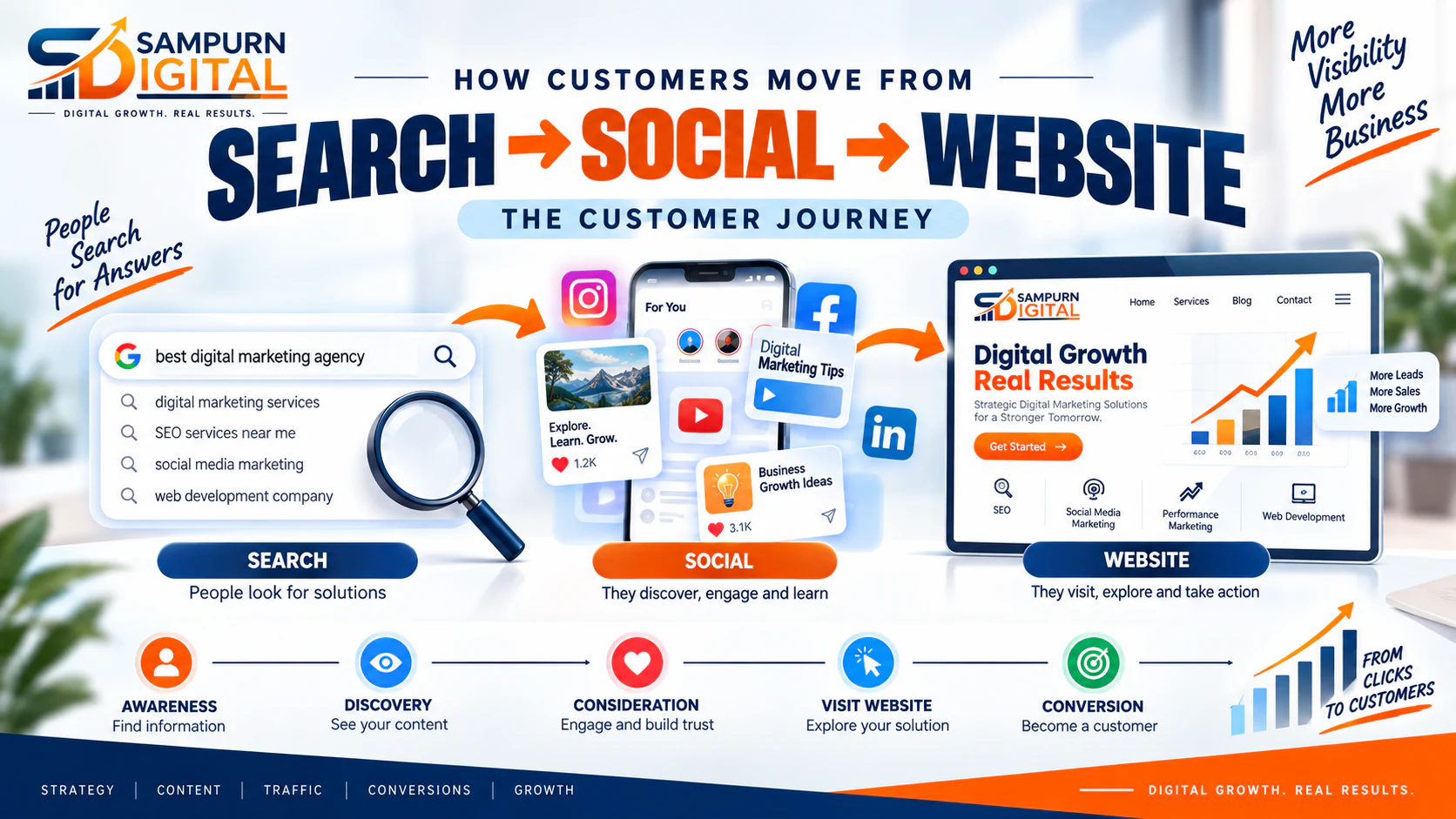
A customer rarely follows a perfectly straight path from discovering a business to becoming a customer.
They may find you through Google, visit your website, see your Instagram content a few days later, return through a paid campaign, and finally contact you after reading another page.
That means your digital marketing cannot be understood by looking at each channel separately.
The real question is:
How do customers move between search, social media and your website before they take action?
Understanding this customer journey across search, social and website helps businesses build a connected digital marketing system instead of running disconnected campaigns.
First: Don't Assume the Customer Uses Only One Channel
One of the biggest digital marketing mistakes is assuming that one click equals one customer journey.
For example:
A person searches for:
"best digital marketing agency for startups"
They discover your website through Google.
They read an article.
They leave.
A few days later, they see one of your Instagram posts.
They follow the account.
Later, they search for your company name again.
They visit the website.
Then they contact you.
Which channel generated the customer?
Google?
Instagram?
Your website?
The answer is: all three may have contributed.
The customer did not experience your marketing as separate departments.
They experienced it as one journey.
That is why businesses need to understand the search to social customer journey rather than treating SEO, social media and websites as completely independent activities.
What Does a Cross-Channel Customer Journey Look Like?
A simplified journey might look like this:
But another customer might follow:
There is no single universal path.
The important thing is to understand the different roles each channel can play.
| Channel | Common Role |
|---|---|
| Search | Discovery and demand capture |
| Website | Education, trust and conversion |
| Social media | Awareness, familiarity and engagement |
| Paid advertising | Demand capture, demand creation and remarketing |
| Content | Education and consideration |
| Analytics | Measurement and attribution |
The goal is not to force every visitor through the same path.
The goal is to make every transition between channels useful.
The 5 Stages of the Search → Social → Website Journey
A useful way to understand the journey is to break it into five stages.
Discovery
The customer first becomes aware of a problem, need or potential solution.
They may search Google for:
- digital marketing agency
- SEO services
- social media marketing ideas
- website development company
- how to generate more leads
- how to improve online sales
At this stage, the person may not know your business.
Your job is not necessarily to sell immediately.
Your job is to become relevant.
This is where SEO, educational content and social content can introduce your brand.
For businesses working on organic visibility, understanding [SEO strategy and organic search for businesses](https://www.sampurndigital.com/blog/seo/search-intent-mapping-how-to-match-pages-with-what-people-actually-want) helps connect what customers search for with the pages they actually need.
Website Visit
The customer clicks through to your website.
This is a critical transition.
Search or social media may have created the initial interest, but the website now has to answer:
- Who are you?
- What do you offer?
- Can you solve my problem?
- Why should I trust you?
- What should I do next?
A website should not simply provide information.
It should move the visitor toward the next useful step.
That could be:
- reading another article
- viewing a service
- checking a case study
- submitting an enquiry
- booking a consultation
- making a purchase
If the visitor arrives from a search query but lands on a page that does not match their intent, the journey can stop immediately.
Social Media Reinforcement
Many customers do not make a decision during their first website visit.
They may want to research the business further.
This is where social media can become important.
A visitor might:
- Read your website.
- Check your Instagram profile.
- Look at your recent posts.
- Watch your videos.
- Read comments.
- Follow your account.
- Return later.
Social media can therefore act as a trust and familiarity layer.
It gives customers additional opportunities to understand how a business communicates, what it knows and how active it is.
But this only works when the social content is aligned with the business.
A profile filled with unrelated posts may generate views without helping the customer move toward a decision.
For a stronger audience foundation, see this [social media growth strategy guide](https://www.sampurndigital.com/blog/social-media-marketing/how-to-define-your-social-media-audience-beyond-age-and-location).
Returning to Search
This stage is easy to overlook.
A customer may discover your brand through social media but later return to Google to investigate.
For example:
They see an Instagram Reel about SEO.
Then they search:
"Sampurn Digital SEO services"
"Sampurn Digital reviews"
"SEO agency for startups"
The customer is now using search differently.
The first search may have been about a problem.
The second search may be about the company or solution.
This means branded search and non-branded search can represent very different stages of the journey.
Your search strategy should account for both.
Conversion
Eventually, the customer needs a clear next step.
That might be:
- Contact Us
- Request a quote
- Book a consultation
- Buy a product
- Start a trial
- Submit a lead form
- Call the business
This is where your website becomes the conversion layer.
Search and social media can generate attention.
But the website often has to turn that attention into an actual business outcome.
This is why [how conversion-focused web development works](https://www.sampurndigital.com/blog/web-development/website-requirements-checklist-before-hiring-a-developer) should be considered part of the marketing system rather than a separate technical project.
Why Customers Move Between Channels
Customers switch channels because each channel answers different questions.
Imagine a customer considering a digital marketing agency.
Google answers:
"Who can help me?"
Website answers:
"What exactly do they do?"
Social media answers:
"Do I trust this brand?"
Content answers:
"Do they actually understand my problem?"
Case studies answer:
"Have they helped businesses like mine?"
Contact page answers:
"How do I take the next step?"
The channels work together because the customer has different questions at different moments.
A strong digital marketing strategy recognizes this.
The Most Common Cross-Channel Journey Patterns
Not every business needs the same customer journey.
However, several patterns appear frequently.
Pattern 1: Search → Website → Conversion
This is common for high-intent searches.
Example:
This journey can be relatively short because the customer already has strong intent.
Pattern 2: Search → Blog → Social → Website → Conversion
This is common for customers who need more education.
Example:
The first interaction is informational.
The eventual conversion is commercial.
Pattern 3: Social → Website → Search → Website
A customer may first discover a brand through social content.
Then they want more information.
So they search Google.
They return to the website.
This is especially common when social content creates awareness but the customer needs additional research before making a decision.
Pattern 4: Paid Ad → Website → Social → Retargeting → Conversion
A paid campaign may generate the first visit.
The visitor does not convert.
They later interact with the brand on social media.
A retargeting campaign brings them back.
They convert on the second or third visit.
Looking only at the final conversion source would hide much of this journey.
Why Your Website Should Be the Connection Layer
Your website should not exist separately from your SEO and social media strategy.
It should connect them.
Think of the website as the central destination:
This does not mean every customer needs to follow every step.
It means your ecosystem should allow customers to move naturally between them.
For example:
A blog article can introduce a problem.
That article can link to a service page.
The service page can link to a case study.
The page can include social proof.
The customer can then submit an enquiry.
The entire journey feels connected.
What Happens When the Channels Are Not Connected?
Disconnected marketing creates friction.
Imagine this scenario.
Your SEO team creates an article about lead generation.
Your social media team posts completely unrelated content.
Your website service pages use different messaging.
Your paid ads promote another offer.
Your landing pages use different terminology.
Your analytics cannot connect the interactions.
You may still generate traffic.
But the customer experience becomes fragmented.
This can contribute to the exact problem discussed in [how to improve your digital marketing is getting traffic but not enough customers](https://www.sampurndigital.com/blog/digital-marketing/why-your-digital-marketing-is-getting-traffic-but-not-enough-customers).
The problem is not necessarily that one channel is failing.
The problem may be that the channels are not helping one another.
How to Build a Connected Customer Journey
You do not need a complicated marketing technology stack to start.
Begin with the journey.
Identify the customer's starting point
Ask:
Where does our customer usually discover us?
Possible answers:
- YouTube
- Paid search
- Paid social
- Referral
- Direct traffic
Do not assume the answer.
Use your analytics and customer conversations.
Identify the customer's next question
After discovering your business, what does the customer want to know?
For example:
Search: "How much does SEO cost?"
Then:
Website: "What does this agency actually provide?"
Then:
Social: "Can I trust them?"
Then:
Website: "How do I contact them?"
Every stage should answer the next question.
Map content to each stage
Create content that supports the journey.
For example:
| Journey Stage | Useful Content |
|---|---|
| Awareness | Educational blog posts |
| Problem recognition | Diagnostic content |
| Research | Guides and comparisons |
| Trust | Case studies and proof |
| Evaluation | Service pages |
| Conversion | Consultation/contact pages |
This prevents content from being created simply because a content calendar says something needs to be published.
Connect Search Intent With Social Content
Your SEO and social teams should not work from completely different topic lists.
Suppose your SEO strategy identifies a valuable topic:
"Why website traffic is not converting"
Your social team can create:
- A Reel explaining the problem
- A carousel showing common mistakes
- A short video with a diagnostic checklist
- A LinkedIn post explaining the funnel
- A story linking to the article
Now one business problem becomes multiple connected touchpoints.
The customer can discover the idea on social media and explore it further on your website.
Make the Website Ready for the Journey
The website should make it easy for visitors to continue researching.
Important elements include:
- Clear navigation
- Relevant internal links
- Strong service pages
- Helpful supporting content
- Clear calls to action
- Trust signals
- Mobile-friendly experience
- Fast page loading
- Consistent messaging
The technical and structural requirements should be considered before development or redesign begins.
Give Every Channel a Job
Do not ask:
"Which channel should we post on?"
Ask:
"What role should this channel play in the customer journey?"
For example:
SEO
Capture existing demand.
Social Media
Build awareness and familiarity.
Paid Advertising
Accelerate demand capture or creation.
Website
Educate and convert.
Content
Answer customer questions.
Analytics
Show what is happening.
When each channel has a clear job, the overall system becomes easier to manage.
How to Know Whether the Journey Is Working
Do not evaluate each channel using only its own metrics.
Look at the journey.
For example:
Search
- Organic impressions
- Organic clicks
- Branded searches
- Landing pages
Social
- Reach
- Engagement
- Profile visits
- Website clicks
Website
- Engaged sessions
- Key page visits
- Conversion rate
- Form submissions
- Calls
- Purchases
Business
- Qualified leads
- Sales
- Revenue
- Customer acquisition cost
The ultimate question is not:
"Did Instagram get more views?"
It is:
"Did the overall system help more qualified people move toward becoming customers?"
Don't Expect Every Customer to Follow the Same Path
A customer journey map is a framework, not a rigid railway track.
One person may convert after one Google search.
Another may need:
Another may see ten pieces of content before taking action.
Another may convert immediately from a paid search ad.
Your job is not to force identical journeys.
Your job is to remove unnecessary friction from the journeys that naturally occur.
A Simple Cross-Channel Mapping Framework
You can map your customer journey using five questions.
Where do customers discover us?
List the major discovery channels.
What do they want at that moment?
Identify their intent.
Where do they go next?
Find the next website, social or search interaction.
What information do they need?
Identify the content or proof required.
What action should they take?
Define the next conversion step.
Repeat this process for your major customer segments.
You will quickly see where your digital marketing experience is strong and where customers are being lost.
What a Strong Connected Journey Looks Like
A well-connected digital marketing system might look like this:
The journey may be longer or shorter, but every interaction supports the next one.
That is the real value of integrated digital marketing.
Use Your Existing Content as a Journey
You do not always need to create more content.
Start by connecting what already exists.
For example:
A customer who is trying to understand the overall funnel can begin with [a practical digital growth funnel guide](https://www.sampurndigital.com/blog/digital-marketing/the-complete-digital-growth-funnel-from-first-click-to-customer).
From there, they may need to understand channel selection.
That is where [which marketing channel should your business invest in first explained for businesses](https://www.sampurndigital.com/blog/digital-marketing/which-marketing-channel-should-your-business-invest-in-first) becomes relevant.
Once the channel strategy is clear, the next step can be a broader implementation roadmap through [our guide to build a 90-day digital marketing roadmap](https://www.sampurndigital.com/blog/digital-marketing/how-to-build-a-90-day-digital-marketing-roadmap).
This creates a connected learning path instead of isolated blog posts.
The Bigger Picture
The customer does not care whether your company has separate SEO, social media, paid advertising and web development teams.
They only experience the brand.
If the message changes dramatically between Google, Instagram and your website, trust can decrease.
If the content answers one question but the landing page answers another, the journey becomes harder.
If social media creates awareness but the website has no clear next step, interest can disappear.
If your website converts visitors but your marketing channels attract the wrong audience, the system still struggles.
The strongest digital marketing strategy therefore connects the entire journey.
Together, they create a digital growth system.
Quick Customer Journey Checklist
Before you consider your digital marketing journey connected, check:
- Do you know where customers usually discover your business?
- Do your SEO topics match real customer questions?
- Does your social content reinforce important business topics?
- Do search visitors land on relevant pages?
- Can visitors easily move from content to services?
- Does your website provide enough trust signals?
- Can social visitors easily reach relevant website pages?
- Are your calls to action clear?
- Is your messaging consistent across channels?
- Can you measure important customer actions?
- Do you understand assisted interactions, not only last-click conversions?
- Do your marketing teams share customer and campaign insights?
If several answers are "no," your biggest opportunity may not be generating more traffic.
It may be connecting the traffic you already have.
